
86-0769-89610677 / 86-13553838770 | info@jinjiadongli.com
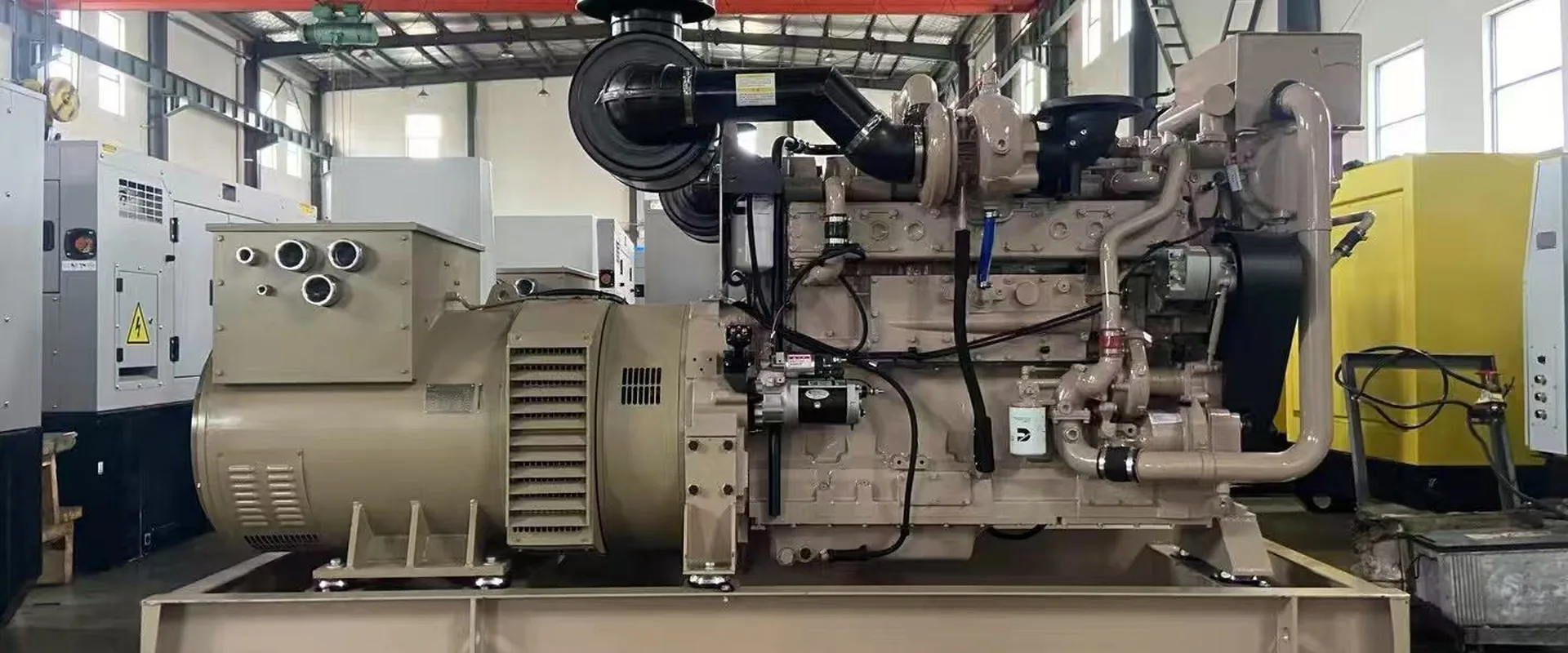
JJP-M240GF — 300 kVA / 240 kW prime, 330 kVA / 264 kW standby. 433 A per phase at 400 V, 53.7 L/h at full load. FOB China quoted against the engine and alternator you specify.
See the Full Specification300 kVA is the prime rating on the nameplate, not a rounded-up figure — the frame maps exactly onto the requirement. 1500 rpm at 50 Hz, 1800 rpm at 60 Hz, three-phase four-wire, 0.8 power factor.
| Voltage | Phase | Current at 300 kVA | Suggested breaker frame |
|---|---|---|---|
| 380 V | 3-phase | 456 A | 630 A |
| 400 V | 3-phase | 433 A | 630 A |
| 415 V | 3-phase | 417 A | 630 A |
| 440 V | 3-phase | 394 A | 630 A |
| 480 V | 3-phase | 361 A | 630 A |
| 220 V | 1-phase | 1,364 A | special winding |
| 240 V | 1-phase | 1,250 A | special winding |
I = kVA × 1000 ÷ (√3 × V). Breaker sizing at 125% of the 400 V figure gives 541 A, which lands on a 800 A frame. Cable at the 400 V figure needs roughly 2 × 95 mm² copper per phase for a run under 50 m.
| Load | Diesel L/h | US gal/h |
|---|---|---|
| 300 kVA / 240 kW (100%) | 53.7 L/h | 14.2 |
| 240 kVA / 192 kW (80%) | 43.0 L/h | 11.4 |
| 180 kVA / 144 kW (60%) | 32.2 L/h | 8.5 |
| 120 kVA / 96 kW (40%) | 21.5 L/h | 5.7 |
| 60 kVA / 48 kW (20%) | 10.7 L/h | 2.8 |
Based on ≤187 g/kWh at 835 g/L diesel density — the same basis used across this site, so the figures compare directly with our other ratings. Consumption tracks load almost linearly in this class. The exact curve for the engine finally fitted is issued with the test report.
| Brand | Engine model | Rating | Standby output | Cylinders |
|---|---|---|---|---|
| Yuchai | YC6MK420-D30 | 420 PS | 309 kW | 6-cyl |
Coupled to a Faraday FD4M-4 alternator, with a Deep Sea DSE7320 MKII controller as standard and DSE8610 for parallel operation. The Yuchai figure above is the engine rating; it clears the 240 kW prime requirement with margin, which is the match we apply across the range (engine sized at 1.1–1.15× the alternator output). Weichai, Cummins, Perkins and Volvo equivalents in the same power band are available on request — tell us the brand your service network already stocks and we will confirm the model and the price against it.
Overall dimensions and dry weight move with the engine and the alternator actually fitted, so we do not publish a single figure for this rating and then quote you a set that does not match it. The general arrangement drawing issued with your order carries the exact envelope, lifting points and centre of gravity for the configuration you buy.
What does not change is the site work. Allow clearance at the alternator end for cooling air, confirm canopy door swing on both long sides before siting, and cast a level concrete plinth rated for 1.5× the wet weight. At this rating the open set is still a forklift lift; a canopied version needs a crane or a heavy forklift.
Ask for the drawing for the engine you are considering — it is the only number worth designing a plant room around.
At this rating the same frame spans a wide band between a Yuchai or Weichai build and a Cummins or Perkins build, so a single published figure would be misleading. We quote this rating against the engine and alternator you specify rather than publishing a catalogue band. What we need to give you a firm number: running kW and the largest motor, the duty (standby, prime or continuous), the destination port, and whether you want open skid, silent canopy or container. From those we confirm the engine option, the tank size and the canopy grade, and price it landed-ready. A sound-attenuated canopy typically adds 8–12% and roughly 200–300 kg at this rating; a synchronising panel, an ATS and the breaker are priced separately because they depend on the switchboard you already have.
433 A per phase at 400 V three-phase, 456 A at 380 V, 361 A at 480 V. Size the breaker at 125% of the 400 V figure: that gives 541 A, which lands on a 800 A frame.
Weight depends on the engine and alternator fitted, so we do not publish a single figure for this rating. The general arrangement drawing issued with your order carries the exact dry weight, the lifting points and the centre of gravity for the configuration you buy — ask for it for the engine you are considering before you design the plant room.
About 53.7 L/h at full 240 kW load and 26.9 L/h at half load, on the ≤187 g/kWh basis used across this site. Consumption is close to linear with load in this class, so the fuel bill per kWh barely moves between 50% and 100% load.
At 0.8 power factor, yes — 300 × 0.8 = 240 kW. A lower site power factor reduces the usable kW further, so check the PF before confirming the rating.
330 kVA / 264 kW, which is 10% above prime. Standby is for loss of mains only and is rated at 200 hours a year; if the set runs as the main supply, specify it at prime instead.
Yes, with the DSE8610 controller, matching alternator pitch and a synchronising panel. Two sets give 600 kVA total, or N+1 redundancy at 300 kVA. Specify it at the quote stage — retro-fitting is expensive.
The Yuchai YC6MK420-D30 is the configuration in our standard quotation for this rating. Weichai, Cummins, Perkins and Volvo equivalents in the same power band are available on request. Choose on parts availability where you operate: Cummins and Perkins have the widest network across Africa and the Middle East, Weichai and Yuchai are the cost-competitive options with strong regional support, Volvo suits projects with emission or brand requirements.
65–75 dB(A) at 7 m for a canopied set, depending on acoustic grade. Residential-grade units sit at the low end; standard export canopies at the high end. Open skid sets are not normally specified where noise matters.
Running kW, largest motor, duty and destination port — we will confirm the engine option, the tank size and the canopy grade, and price it landed-ready.
Request a Quote