
86-0769-89610677 / 86-13553838770 | info@jinjiadongli.com
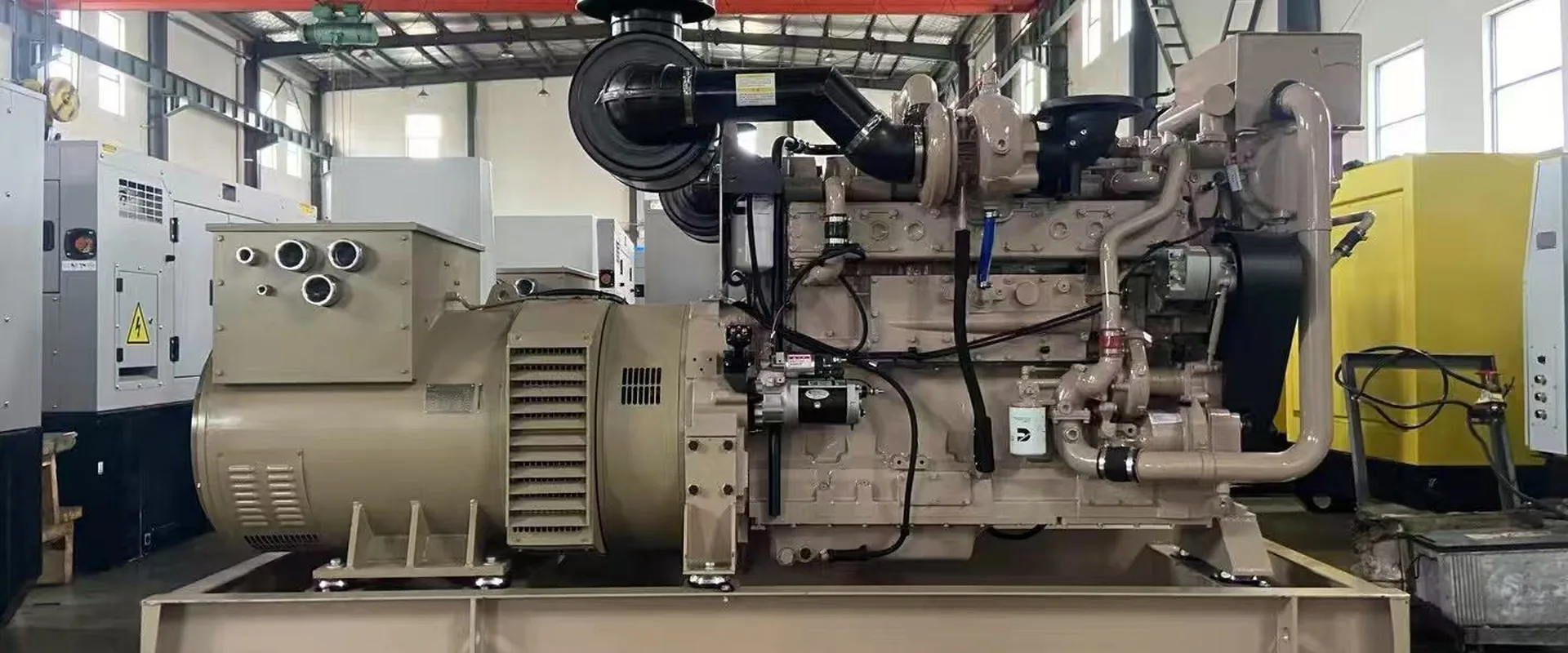
JJP-M400GF — 500 kVA / 400 kW prime, 550 kVA / 440 kW standby. 722 A per phase at 400 V, 3500 × 1500 × 2000 mm, 2300 kg, 88.6 L/h at full load.
See the Full Specification500 kVA is the one round number in this range that maps exactly onto a standard frame. No oversizing, no compromise — the 500 kVA figure on the brief is the prime rating on the nameplate. 1500 rpm at 50 Hz, 1800 rpm at 60 Hz, three-phase four-wire, 0.8 power factor.
| Configuration | Dimensions L × W × H | Weight |
|---|---|---|
| Open skid | 3500 × 1500 × 2000 mm | 2300 kg |
| Silent canopy | +300 mm per dimension → 4100 × 2100 × 2600 mm | 2480–2550 kg |
| With fuel (400 L tank) | — | +340 kg approx. |
At 2.3–2.55 t this is a crane or heavy-forklift lift, not a pallet truck job. For a canopied set allow a 4.1 m × 2.1 m footprint plus 1 m clearance on the alternator end for cooling air, and cast a level concrete plinth rated for 1.5× the wet weight. Confirm door swing before siting — the lockable access panels open on both long sides.
| Voltage | Phase | Current at 500 kVA | Suggested breaker frame |
|---|---|---|---|
| 380 V | 3-phase | 760 A | 1000 A |
| 400 V | 3-phase | 722 A | 1000 A |
| 415 V | 3-phase | 696 A | 800 A |
| 440 V | 3-phase | 656 A | 800 A |
| 480 V | 3-phase | 601 A | 800 A |
| 220 V | 1-phase | 2273 A | special winding |
| 240 V | 1-phase | 2083 A | special winding |
I = kVA × 1000 ÷ (√3 × V). Breaker sizing at 125% of the 400 V figure gives 903 A, so a 1000 A frame is the usual choice. Cable at 722 A needs roughly 2 × 185 mm² copper per phase for a run under 50 m, or a busbar trunking system above that. Single-phase 500 kVA sets are not practical — balance across three phases instead.
| Load | Output | Diesel L/h | US gal/h | Per kVA per hour |
|---|---|---|---|---|
| 100% (prime) | 500 kVA / 400 kW | 88.6 L/h | 23.4 | 0.177 L |
| 80% | 400 kVA / 320 kW | 70.9 L/h | 18.7 | 0.177 L |
| 60% | 300 kVA / 240 kW | 53.2 L/h | 14.0 | 0.177 L |
| 40% | 200 kVA / 160 kW | 35.4 L/h | 9.4 | 0.177 L |
| 20% | 100 kVA / 80 kW | 17.7 L/h | 4.7 | 0.177 L |
Based on ≤185 g/kWh at 835 g/L diesel density. Consumption is close to linear with load in this class, which makes the daily fuel bill easy to budget: hours × load fraction × 88.6 L. A set held at 40% load for 12 hours a day burns about 425 L — plan tank capacity and refuelling access around that number, not around full load.
| Brand | Engine model | Standby output | Cylinders | Displacement |
|---|---|---|---|---|
| Cummins | QSK19-G13 | 451 kW | 6-cyl | 19 L |
| Weichai | WP13D448E200 | 448 kW | 6-cyl | 12.5 L |
| SDEC | G-series | 440 kW | 6-cyl | 16 L |
| Perkins | 2506A-E15TAG2 | 440 kW | 6-cyl | 15 L |
| Volvo | TAD1231GE | 425 kW | 6-cyl | 12.1 L |
Coupled to a Leroy Somer LSA46.3S5 or Stamford HCI544 alternator. Deep Sea DSE7320 MKII controller as standard, DSE8610 for parallel operation. At this rating the engine choice drives both price and serviceability — Cummins QSK19 has the widest parts network in Africa and the Middle East; Weichai and SDEC are the cost-competitive options with strong regional support; Perkins and Volvo suit projects with emission or brand requirements.
At 500 kVA the redundancy question usually decides the project more than the price does. A single JJP-M400GF is the cheapest way to cover the load, but a single set is also a single point of failure. Two 250 kVA sets in parallel cost 15–25% more and give N+1: one set carries the essential load while the other is serviced, and both share load at peak.
| Configuration | Coverage | Redundancy | When it is right |
|---|---|---|---|
| 1 × JJP-M400GF | 500 kVA | None | Factory, hotel or site where a planned outage is acceptable |
| 2 × 250 kVA parallel | 500 kVA shared | N+1 | Hospital, data centre, telecom — load must not drop |
| 2 × JJP-M400GF parallel | 1000 kVA | N+1 at 500 kVA | Load above 500 kVA, or growth planned within 3 years |
Parallel operation requires the DSE8610 controller, matching alternator pitch, a shared load bus and a synchronising panel. Retro-fitting parallel capability after delivery is expensive — decide it at the quote stage.
Open-skid JJP-M400GF sets run US$28,000–38,000 FOB China. Engine brand moves that band more than anything else — Cummins QSK19 and Perkins 2506A sit at the top, Weichai and SDEC at the bottom. A sound-attenuated canopy adds 8–12% and about 200 kg. Budget separately for a 1000 A breaker, an ATS if the site needs automatic transfer, a synchronising panel if two sets run in parallel, and freight — a 2.5 t canopied unit is a 40 ft container shipment with the fuel tank drained.
722 A per phase at 400 V three-phase, 760 A at 380 V, 696 A at 415 V, 601 A at 480 V. Size the breaker at 125% of the 400 V figure — 903 A, so a 1000 A frame.
2300 kg on an open skid, 3500 × 1500 × 2000 mm. The silent canopy adds 180–250 kg and 300 mm per dimension, giving about 2.5 t before fuel. Add roughly 340 kg for a full 400 L tank.
88.6 L/h at full 500 kVA load, 70.9 L/h at 400 kVA, 53.2 L/h at 300 kVA. That is 0.177 L per kVA per hour — consumption is close to linear with load in this class.
At 0.8 power factor, yes — 500 × 0.8 = 400 kW. If the load has a lower power factor, the usable kW drops further. Motors and transformers pull the PF down; check the site PF before confirming the rating.
Yes, with the DSE8610 controller, matching alternator pitch and a synchronising panel. Two sets give 1000 kVA total, or N+1 redundancy at 500 kVA. Decide this at the quote stage — retro-fitting is expensive.
Cummins QSK19 for parts availability across Africa and the Middle East; Weichai WP13D or SDEC G-series for cost with strong regional support; Perkins 2506A and Volvo TAD1231 where emission compliance or brand specification matters.
65–75 dB(A) at 7 m for the canopied set, depending on acoustic grade. Above 500 kVA, site noise limits usually call for a residential-grade canopy or an acoustic enclosure with a remote radiator.
Three-phase, always, at this rating. A single-phase 500 kVA winding would be a bespoke alternator pulling 2273 A at 220 V — impractical. If the site is single-phase, split the load across three phases.
A level concrete plinth rated for 1.5× the wet weight, with anti-vibration mounts under the baseframe. Allow 1 m clearance at the alternator end for cooling air, and confirm canopy door swing on both long sides before siting.
Running kW, largest motor, and whether redundancy matters — we will quote the single 500 kVA set against the parallel option so the trade-off is visible.
Request a Quote