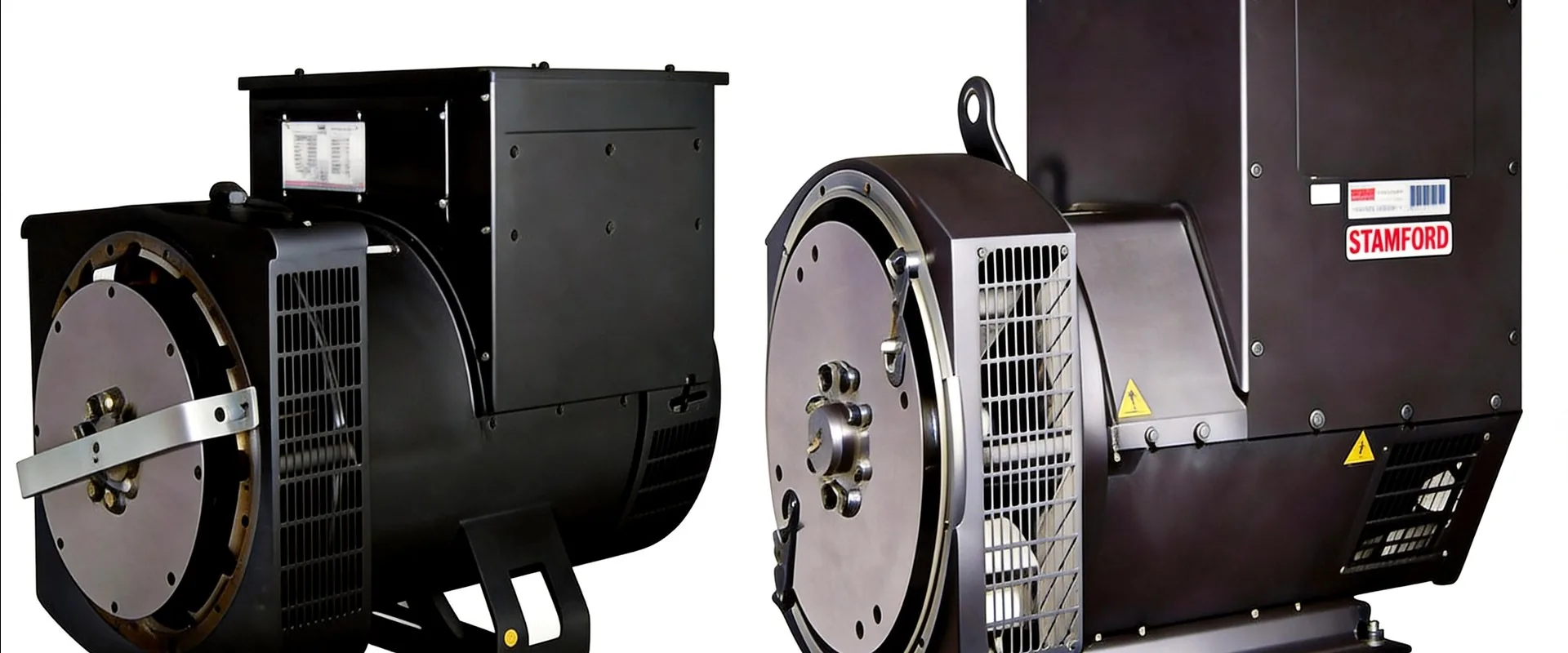
AC Alternator Complete Buying Guide
How Does an AC Alternator Work?
An AC alternator converts mechanical energy into electrical energy through electromagnetic induction. When a conductor (stator winding) is exposed to a rotating magnetic field (produced by the rotor), an alternating voltage is induced across the conductor terminals. The fundamental principle follows Faraday's Law of Electromagnetic Induction: EMF = -N(dΦ/dt), where N is the number of turns and Φ is the magnetic flux.
The stator is the stationary part containing three-phase windings distributed in slots around the inner periphery. The rotor is the rotating part that generates the magnetic field. In brushless alternators—the industry standard for diesel generators—the rotor contains an exciter winding and a main field winding, connected through a rotating rectifier assembly. This eliminates the need for carbon brushes and slip rings, dramatically reducing maintenance requirements.
Excitation methods include:
- Permanent Magnet Generator (PMG) excitation: Provides a constant power source for the AVR independent of the alternator output. Ideal for applications with high inrush currents (motor starting, welding) and non-linear loads. Offers 300% sustained short-circuit current for 10 seconds.
- Shunt (self) excitation: The AVR draws power from the alternator's own output terminals. More cost-effective but provides lower short-circuit sustainment (typically 200% for 5 seconds). Suitable for resistive and lightly inductive loads.
- Auxiliary Winding (AREP) excitation: A hybrid approach using a separate auxiliary winding embedded in the stator to power the AVR. Provides better short-circuit performance than shunt excitation while being more economical than PMG.
Key Technical Parameters Explained
Power Rating (kVA)
AC alternators for diesel generator sets span a wide power range from 5 kVA to 3,000 kVA. The rating is defined at specific conditions: 40°C ambient temperature, 1000m altitude, and continuous duty (S1). Key rating definitions include:
- Standby Rating: Maximum output available for the duration of a utility power interruption. Typically 10% higher than prime rating.
- Prime Rating: Maximum output available for unlimited hours at variable load with a 10% overload capacity for 1 hour in every 12 hours.
- Continuous Rating: Maximum output available 24/7 at constant load. Typically 80-85% of prime rating.
Voltage Configurations
Standard voltage outputs for three-phase alternators:
- 120/240V (Single-phase): Residential and small commercial applications, 60Hz markets
- 208Y/120V: North American commercial buildings, data centers (60Hz)
- 400/230V: European, Asian, African standard (50Hz) — most common worldwide
- 480Y/277V: North American industrial, large commercial (60Hz)
- 600Y/347V: Canadian industrial applications (60Hz)
- 415/240V: UK, Australia, Middle East, Southeast Asia (50Hz)
- 380/220V: China, parts of South America, Middle East (50Hz)
All modern alternators feature 12-lead reconnection capability (T1-T12), allowing field rewiring for different voltage configurations without rewinding.
Frequency and Speed
The relationship between frequency, poles, and speed is defined by: N = 120f/P, where N = speed (RPM), f = frequency (Hz), P = number of poles.
- 60Hz 1800 RPM (4-pole): Standard for North American diesel generators
- 50Hz 1500 RPM (4-pole): Standard for European/Asian/African diesel generators
- 60Hz 3600 RPM (2-pole): Used in small portable generators
- 50Hz 3000 RPM (2-pole): Used in small portable generators
Pole Configuration
| Poles |
60Hz Speed |
50Hz Speed |
Typical Application |
| 2-Pole | 3,600 RPM | 3,000 RPM | Portable generators, small units ≤20kVA |
| 4-Pole | 1,800 RPM | 1,500 RPM | Most diesel generators 20-3000kVA |
| 6-Pole | 1,200 RPM | 1,000 RPM | Low-speed engine coupling, large hydro |
| 8-Pole | 900 RPM | 750 RPM | Special low-speed applications |
Power Factor
The standard power factor for AC alternators is 0.8 lagging. This means the alternator is rated to deliver kVA at a power factor where 80% is real power (kW) and 20% is reactive power (kVAR). Modern alternators can operate from 0.7 to 1.0 power factor, but derating may apply outside the 0.8 rated point. For leading power factor applications (long cables, lightly loaded UPS systems), special consideration is needed to maintain voltage stability.
Insulation Class
| Class |
Max Temperature |
Typical Application |
Expected Life |
| Class B | 130°C | Older designs, light duty | ~20,000 hours at rated temp |
| Class F | 155°C | Industry standard for most alternators | ~20,000 hours at rated temp |
| Class H | 180°C | High-ambient or heavy-duty industrial | ~20,000 hours at rated temp |
Best practice: Class F insulation with Class B temperature rise (80K rise) — this provides a 25°C thermal margin, significantly extending insulation life. Every 10°C reduction in operating temperature doubles insulation life expectancy (Montsinger's rule).
Protection Rating (IP)
| IP Rating |
First Digit (Solids) |
Second Digit (Water) |
Application |
| IP21 | >12.5mm protected | Vertical dripping | Indoor, clean environment |
| IP22 | >12.5mm protected | Dripping at 15° tilt | Indoor, general purpose |
| IP23 | >12.5mm protected | Spraying at 60° | Tropical, outdoor with canopy |
| IP44 | >1mm protected | Splashing from any direction | Outdoor, construction sites |
| IP55 | Dust protected | Low-pressure water jets | Harsh environments, mining, marine |
Temperature Rise
Temperature rise is the difference between the winding temperature and the ambient air temperature. Standard ratings per IEC 60034-1:
- Class F insulation, 80K rise (Class B evaluation): Industry best practice. Winding runs at 130°C max within 155°C insulation limit. Provides 25°C safety margin.
- Class H insulation, 125K rise (Class F evaluation): Heavy-duty. Winding runs at 155°C max within 180°C insulation limit.
- Class F insulation, 100K rise: Tropical/high-ambient applications (50°C ambient).
Winding Pitch
The 2/3 pitch winding (also called 120° coil span) is the industry recommendation for most applications. In a full-pitch winding, each coil spans 180 electrical degrees. In a 2/3 pitch winding, each coil spans 120 electrical degrees. This design inherently eliminates the 3rd harmonic (and all triplen harmonics: 3rd, 9th, 15th) from the line-to-line voltage, resulting in a cleaner sinusoidal waveform. This is critical when:
- Supplying non-linear loads (UPS, computers, variable speed drives)
- Operating in parallel with the utility grid
- Serving loads sensitive to voltage distortion
Full-pitch (5/5 or 180°) winding delivers approximately 15% more output but produces 3rd harmonic content of 5-8%, which can cause neutral overloading in 4-wire systems.
Automatic Voltage Regulator (AVR)
The AVR maintains output voltage within tight tolerances despite load variations. Key performance specifications:
- Steady-state voltage regulation: ±0.5% (typical for digital AVR), ±1% (analog AVR)
- Transient voltage dip: ≤15% for 100% step load application
- Transient voltage recovery time: ≤1.5 seconds to within ±1% of final value
- Under-frequency protection: Rolls off excitation below 95% rated frequency to prevent overheating
- Volts-per-Hertz (V/Hz) limiting: Prevents magnetic core saturation during overspeed or load rejection
Total Harmonic Distortion (THD)
THD measures the purity of the output voltage waveform:
- <3% THD (non-linear load): Required for data centers, hospitals, and sensitive electronic equipment
- <5% THD (linear load): Standard for general-purpose industrial and commercial applications
A 2/3 pitch winding combined with proper magnetic circuit design achieves these levels. High THD causes overheating in motors, transformers, and neutral conductors.
How to Choose the Right Alternator
Selecting the correct alternator requires matching multiple parameters to your application:
- Determine power requirement: Calculate total connected load in kW, apply diversity factor (typically 0.7-0.85), then convert to kVA using power factor (kVA = kW / PF).
- Select frequency: Match to your country's grid standard — 60Hz for Americas/Japan/Korea, 50Hz for Europe/Asia/Africa.
- Choose voltage: Must match existing distribution system or equipment nameplate ratings.
- Determine pole count: Match to engine rated speed — most diesel engines for generator sets run at 1800 RPM (60Hz) or 1500 RPM (50Hz), requiring 4-pole alternators.
- Select IP rating: IP21/IP23 for indoor installations; IP44 for construction/outdoor; IP55 for marine, mining, and harsh environments.
- Consider excitation type: PMG for high inrush/motor-starting loads; shunt for general-purpose; AREP for mixed loads.
- Verify altitude/ambient derating: Above 1000m altitude or 40°C ambient, alternators require derating per IEC 60034-1.
Parallel Operation Requirements
When running alternators in parallel (common in N+1 redundancy configurations), proper load sharing is essential:
- Droop (Speed Droop) Mode: Each generator's speed governor is set with a 3-5% droop characteristic. As load increases, speed decreases proportionally. This provides stable parallel operation without requiring communication between units. Voltage droop (4% reactive droop) ensures reactive load sharing. This is the preferred method for utility-parallel systems.
- Isochronous (Zero Droop) Mode: The governor maintains constant speed regardless of load. When used in parallel, an isochronous load sharing controller (load sharing module) distributes active and reactive load via digital communication. Provides tighter frequency and voltage regulation. Required for standalone (island) mode with multiple generators.
- Master-Slave Mode: One generator acts as the master, setting voltage and frequency reference. Slave units follow the master's commands. Simple but creates a single point of failure.
For successful parallel operation, alternators must have: matching voltage ratios, matching impedance (% Z within 10%), same winding pitch, and compatible AVR response characteristics.
Leading AC Alternator Brands & Models
We supply alternators from all major global manufacturers. Below is a detailed comparison of the leading brands, their key model series, and specifications to help you make an informed purchasing decision.
1. Stamford (Cummins Generator Technologies)
Stamford is the world's most widely specified alternator brand, manufactured by Cummins Generator Technologies. With over 100 years of engineering heritage, Stamford alternators are the industry benchmark for reliability and performance.
- P7 Series (400-2,000 kVA): The flagship 4-pole alternator for medium-to-large diesel gensets. Features Class H insulation (180°C), IP23 protection, brushless design with rotating rectifier. Equipped with Deep Sea Electronics or Stamford SX460 AVR. Standard 2/3 pitch winding. Efficiency up to 96.5%. Compliant with BS EN 60034, IEC 60034, and NEMA MG1. Available with PMG or AREP excitation options.
- UCDI/X Series (20-250 kVA): Compact 4-pole alternators for small-to-medium gensets. Class F insulation with Class B rise. IP21 standard with IP44 optional. Integral fan cooling. Ideal for construction, agriculture, and light industrial standby power.
- HC Series (800-3,000 kVA): Heavy-duty alternators for large industrial and utility-scale power generation. Designed for 20,000+ hour continuous operation. Class H insulation with Class F temperature rise (125K). Features advanced bearing system with insulated bearings to prevent circulating currents. Optional water-cooled variant for containerized applications.
- S0/S1 Series (5-30 kVA): Single-bearing, compact alternators for portable generators and light tower applications. Self-excited with built-in AVR. IP21 protection. Lightweight design at 45-95 kg. 2-pole and 4-pole options.
2. Leroy-Somer (Nidec)
Leroy-Somer, now part of Nidec Corporation, is a French alternator manufacturer with over 130 years of experience. Known for innovative digital regulation technology and exceptional efficiency.
- LSA 47 Series (250-1,000 kVA): 4-pole alternator with patented ADV4 digital AVR. Class H insulation, IP23 protection. Features patented "Elastodynamic" rotor for reduced vibration and noise. Efficiency up to 96.8%. Winding optimized for non-linear load capability with <3% THD. 12-lead reconnectable. Suitable for data centers, telecom towers, and construction.
- LSA 50/51 Series (500-1,600 kVA): High-power 4-pole alternators for prime and continuous duty. Class H insulation with Class F rise. Integrated PMG option. Designed for 50°C ambient operation without derating. Advanced bearing system with regreasing intervals up to 20,000 hours.
- LSA 40/42/43 Series (20-200 kVA): Compact range for small diesel gensets. Self-excited with analog AVR. IP21/IP23 protection. Single-bearing design. Lightweight and cost-effective for construction and agricultural standby.
- TAL Series (10-150 kVA): Economy-range alternators for cost-sensitive applications. Simplified design with reliable performance. Ideal for rental fleet and standby applications in developing markets.
3. Marathon Electric (Regal Beloit)
Marathon Electric, part of Regal Beloit Corporation, is a North American alternator manufacturer known for rugged construction and advanced protection systems.
- MA Series (18-450 kW / 22.5-562.5 kVA): 4-pole brushless alternators with Marathon's proprietary VIP (Vacuum Pressure Impregnated) insulation system. Class F insulation with Class B rise. Integrated Thermoguard™ embedded temperature sensors (RTDs) for real-time winding temperature monitoring. Standard 2/3 pitch. Meets UL 1004, CSA C22.2, and IEEE 115. Designed for -40°C to +60°C ambient range.
- MB/MC Series (500-1,500 kW): Large-frame alternators for industrial prime power. VIP insulation with embedded thermistors. Double-row spherical roller bearings for extended life (L10 bearing life >100,000 hours). Available with Marathon DigiPlus™ digital AVR featuring soft start, load acceptance tuning, and programmable V/Hz protection.
- MD Series (1,500-2,000+ kW): Ultra-large frame for power plant and heavy industrial applications. Class H insulation. IP23 standard with IP44 optional. Designed for 24/7 continuous duty at rated conditions.
- SN Series (Marine): Marine-certified alternators with ABS, DNV, Lloyd's Register, and Bureau Veritas approvals. Salt-mist resistant windings with epoxy coating. IP44/IP55 protection. Vibration-tested per IEC 60068-2-6. Available in 50Hz and 60Hz variants.
4. Mecc Alte
Mecc Alte is an Italian alternator manufacturer with 40+ years of experience, specializing in medium-to-large power generation alternators. Known for their advanced digital regulation technology.
- ECO 32/38/40/43 Series (5-400 kVA): Compact 4-pole alternators with Arex™ digital AVR. Class F insulation with Class B rise. IP21 standard, IP44 optional. Features DVC (Digital Voltage Control) system for precise voltage regulation (±0.5%). Integrated EMI filtering for reduced electromagnetic interference. 2/3 pitch standard. Efficiency up to 95%.
- T 33/40/44/50 Series (500-2,500 kVA): Large-frame alternators for industrial and utility applications. Class H insulation with Class F rise. PMG standard on all T-series models. Features advanced Arex™ Plus digital AVR with parallel load sharing capability, CAN bus communication, and programmable protection functions. Designed for 50°C ambient without derating.
- ECO 46/48 Series (350-800 kVA): Mid-range alternators bridging the gap between ECO and T series. Cost-effective solution for commercial standby power. Standard 2/3 pitch, 12-lead reconnectable.
5. Other Major Brands We Supply
- Geneq (China): Cost-effective Stamford-compatible alternators, 5-2000kVA. ISO 9001:2015 certified.
- Faraday Electric (China): Leroy-Somer-compatible designs, 10-1500kVA. CE certified.
- ChaoLi (China): Budget-friendly range for rental and standby, 5-800kVA.
- Baldor (ABB): NEMA-standard alternators for North American market.
- Newage (Cummins): Stamford-compatible economy range.
AC Alternator Application Scenarios
Data Center Standby Power
Data centers represent the most demanding alternator application. Tier III facilities require N+1 redundancy with 99.982% uptime; Tier IV requires 2N+1 with 99.995% uptime. Key alternator requirements include:
- Voltage transient: ≤10% dip on 100% step load, recovery to ±1% within 1 second. Motor starting (CRAC units, chillers) can draw 600% inrush current.
- Excitation: PMG excitation is mandatory for data center applications due to superior short-circuit sustainment (300% for 10 seconds) and independent voltage regulation.
- Harmonic performance: <3% THD under 100% non-linear load (IT loads with switch-mode power supplies create significant 3rd, 5th, and 7th harmonics).
- Parallel operation: Isochronous load sharing with digital communication between units. Typically 3-6 generators in an N+1 or 2N configuration. Load sharing accuracy: ±2% active, ±5% reactive.
- Recommended: Stamford P7/HC with PMG, or Leroy-Somer LSA 47/50 with ADV4+PMG.
Hospital & Healthcare Facilities
Hospitals fall under NFPA 110 Level 1 (life safety) requirements, which mandate:
- Power restoration within 10 seconds of utility failure (NFPA 110 Section 7.11)
- Monthly 30-minute load bank testing and annual 4-hour continuous test
- Alternator must accept 100% rated load in a single step within 10 seconds (per NFPA 110 Section 5.3.2)
- Essential electrical system includes: emergency lighting, life support equipment, elevators, fire alarm systems, surgical suites
- Redundancy: Minimum N+1 configuration, with automatic transfer switch (ATS) transfer time ≤10 seconds
- Recommended: Marathon Electric with Thermoguard™ for continuous winding temperature monitoring, or Stamford P7 with PMG excitation for guaranteed load acceptance.
Marine & Shipboard Power
Marine alternators must meet stringent classification society requirements:
- Classification approvals: ABS (American Bureau of Shipping), DNV (Det Norske Veritas), Lloyd's Register (LR), Bureau Veritas (BV), China Classification Society (CCS)
- Salt mist protection: Windings treated with epoxy or polyurethane coating per IEC 60068-2-52. Minimum IP44 rating; IP55 for exposed installations.
- Vibration resistance: Tested per IEC 60068-2-6 (10-150 Hz, 4g acceleration)
- Roll and pitch: Must operate at 22.5° roll, 10° pitch, 7.5° yaw
- Ambient: Engine room ambient can reach 50°C; alternator must be rated or derated accordingly
- Recommended: Marathon SN Series (all major class approvals) or Stamford with marine certification package.
Mining Operations
Mining environments present extreme challenges for alternator performance and durability:
- Dust and contamination: Minimum IP55 protection required. Conductive coal dust, abrasive silica, and metallic particulates can cause winding shorts.
- Altitude derating: Many mines operate at 2,000-4,500m altitude. Per IEC 60034-1, derate 1% per 100m above 1,000m for air density. Above 4,000m, use Class H insulation with forced ventilation.
- Ambient temperature: Mine sites in tropical regions experience 45-55°C ambient. Require high-ambient alternator packages with Class H insulation at Class F rise (125K) or larger frame sizes.
- Heavy load cycling: Haul trucks, crushers, and conveyors create severe step loading. PMG excitation mandatory.
- Recommended: Marathon MB/MD with Thermoguard™, or Stamford HC Series with IP55 enclosure and tropical winding treatment.
Oil & Gas Fields
Oil and gas installations require alternators suitable for hazardous area classification:
- Explosion protection: Per NEC Class I, Division 2 or ATEX Zone 2. Alternators must prevent ignition of flammable gas/air mixtures. Enclosed alternators with pressurized ventilation or increased safety (Ex e) design.
- High ambient: Desert operations can see 55°C ambient. Marine-type (IP55) with Class H insulation required.
- Sand protection: IP55 minimum; filtered air intake with centrifugal pre-filters for sand-laden environments.
- Remote operation: Sites may be hundreds of kilometers from service centers. Alternator must be rated for 20,000+ hours between major service. Extended bearing life and regreasing intervals critical.
- Recommended: Marathon MD Series with IP55, or Leroy-Somer LSA 50/51 with high-ambient tropical package and PMG excitation.
AC Alternator Frequently Asked Questions
What is the difference between 50Hz and 60Hz alternators?
The fundamental difference is the output frequency, which determines the engine operating speed. 50Hz alternators are designed to run at 1,500 RPM (4-pole) and are standard in Europe, Asia, Africa, Australia, and most of the world. 60Hz alternators run at 1,800 RPM (4-pole) and are standard in North America, Japan, South Korea, and parts of Central America. The windings, magnetic circuit, and core laminations are designed differently for each frequency. A 50Hz alternator operated on 60Hz will produce higher voltage (V/Hz ratio increases), potentially saturating the magnetic core. A 60Hz alternator on 50Hz will produce lower voltage and reduced power output. Do not interchange 50Hz and 60Hz alternators unless the manufacturer specifically rates the unit for dual frequency operation.
How do I choose between 2-pole and 4-pole alternators?
The choice depends on your engine speed and application. 2-pole alternators run at 3,600 RPM (60Hz) or 3,000 RPM (50Hz) — used for small portable generators (≤20kVA) where compact size and low cost are priorities. They produce higher frequency harmonics and have shorter bearing life due to higher speed. 4-pole alternators run at 1,800 RPM (60Hz) or 1,500 RPM (50Hz) — the standard for all diesel generators above 20kVA. Lower speed means longer bearing life, lower noise, better vibration characteristics, and superior voltage waveform quality. For any stationary or industrial application, 4-pole is always recommended.
What insulation class do I need for my alternator?
Insulation class determines the maximum operating temperature of the winding. Class B (130°C) is found in older or economy alternators. Class F (155°C) is the current industry standard for most commercial and industrial alternators. Class H (180°C) is used for heavy-duty, high-ambient, or continuous-duty applications. The critical principle is the temperature rise margin: most premium alternators use Class F insulation rated at Class B temperature rise (80K), creating a 25°C safety margin. This margin doubles the insulation life compared to running at the full Class F temperature limit. For tropical climates (45-50°C ambient) or continuous 24/7 operation, specify Class H insulation with Class F rise.
What does IP rating mean for alternators?
IP (Ingress Protection) rating defines the alternator's sealing effectiveness against solid objects and water. The first digit (0-6) indicates protection against solid particles: IP2X protects against objects >12.5mm (fingers), IP4X protects against objects >1mm (wires, small tools), IP5X is dust-protected. The second digit (0-8) indicates water protection: IPX1 = vertical drips, IPX2 = dripping at 15°, IPX3 = spraying at 60°, IPX4 = splashing from any direction, IPX5 = low-pressure water jets. For indoor clean environments, IP21 is sufficient. For outdoor installations under a canopy, IP23 is standard. For construction sites, IP44 is recommended. For marine, mining, or extremely harsh environments, IP55 is mandatory.
Can alternators run in parallel?
Yes, alternators can run in parallel, but specific requirements must be met. Before paralleling, units must be synchronized: matching voltage, frequency, and phase sequence. For sustained parallel operation, proper load sharing is essential. Droop mode (3-5% speed/voltage droop) allows stable parallel operation without communication — preferred for utility-parallel systems. Isochronous mode with a load sharing controller maintains exact frequency and voltage — required for island (standalone) parallel operation. The alternators should have matching impedance (%Z within 10%), same winding pitch (2/3 pitch recommended for parallel), and compatible AVR characteristics. Most modern digital AVRs have built-in parallel functionality with CAN bus or Modbus communication.
What is 2/3 pitch winding and why is it important?
In a 2/3 pitch (120° coil span) winding, each coil spans two-thirds of a pole pitch instead of the full pole pitch. This design inherently eliminates all triplen harmonics (3rd, 9th, 15th) from the line-to-line voltage. The 3rd harmonic is particularly problematic because it adds in the neutral conductor of 4-wire systems, potentially causing neutral currents of 173% of phase current. Using 2/3 pitch winding prevents this. It also reduces telephone influence factor (TIF) for applications near communication equipment and prevents overheating of the neutral bus. The trade-off is approximately 5-8% lower output compared to full-pitch winding, but the benefits for voltage quality and safety make 2/3 pitch the universal standard for generator alternators above 20kVA.
How do I size an alternator for my diesel engine?
Alternator sizing must match the engine's available power at the rated speed. Engine power (kW) × engine efficiency × alternator efficiency = alternator output (kW). As a rule of thumb: the alternator's continuous kVA rating should not exceed 80% of the engine's flywheel horsepower × 0.746 (to convert HP to kW), divided by 0.8 power factor. The engine must also be capable of absorbing the alternator's full rated torque plus transient load demands. For motor-starting applications, verify that the engine has sufficient torque reserve to handle the alternator's peak reactive current during motor inrush (typically 600% of motor FLA for 3-5 seconds). Always consult both the engine and alternator manufacturer's application engineering guidelines.
What maintenance does an alternator require?
Modern brushless alternators require minimal maintenance compared to brushed types. Key maintenance items include:
- Bearing inspection/replacement: Check bearings every 8,000-10,000 hours. Replace at 20,000-40,000 hours depending on operating conditions and bearing type.
- Winding insulation resistance: Measure with megohmmeter (500V DC) annually. Minimum acceptable: (Voltage + 1000) / 1000 megohms per IEEE 43. Below 1 megohm indicates moisture ingress or insulation degradation.
- Cleaning: Blow out dust and debris with compressed air (dry, oil-free) at low pressure. Clean air filters on enclosed units.
- Rotating rectifier check: Test diodes with multimeter annually. Replace failed diodes immediately.
- AVR verification: Check voltage regulation accuracy and response time. Calibrate or replace if out of specification.
- Connection torque: Re-torque all terminal connections annually per manufacturer specifications.
What is the difference between brush and brushless alternators?
Brush-type alternators use carbon brushes and slip rings to transfer DC excitation current to the rotating field winding. They are simpler, less expensive, and easier to repair, but require regular brush replacement (every 1,000-2,000 hours), slip ring maintenance, and are prone to carbon dust contamination. Brushless alternators use a separate exciter stator and a rotating rectifier to generate the field current without any physical contact. They have no wear parts in the excitation circuit, require zero maintenance for excitation components, and produce no carbon dust. Virtually all alternators above 20kVA manufactured today are brushless. The only remaining applications for brush-type alternators are very small portable units or legacy equipment where replacement parts are readily available.
How do altitude and temperature affect alternator performance?
Both altitude and ambient temperature reduce air density, which decreases the alternator's cooling capacity. Per IEC 60034-1:
- Altitude: Above 1,000 meters, derate 1% per 100m for the reduced cooling capacity of thin air. At 3,000m, derate 20%. Above 4,000m, special high-altitude designs are required.
- Ambient temperature: Standard rating is at 40°C ambient. Above 40°C, derate per manufacturer's curves (typically 0.5-1.0% per °C above 40°C). At 50°C ambient, derate 5-10%.
- Combined altitude + temperature: Derating factors multiply. At 3,000m and 50°C ambient, total derating can reach 25-30%, requiring a significantly larger alternator frame.
For tropical or high-altitude installations, specify alternators with Class H insulation at Class F rise (providing additional thermal headroom), IP55 protection with forced ventilation, or purpose-built tropical/high-altitude variants.