86-0769-89610677 / 86-13553838770 | info@jinjiadongli.com
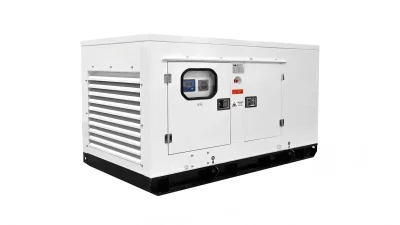
Model: K16H II
Power: 13KW 16KVA Standby / KW KVA Prime
Status: Brand New, 2 Years International Warranty
Volume, OEM and project pricing available on request.
| Model | K16H II |
| Brand | KOHLER |
| Series | K series (stationary, value) |
| Standby Output | 13 kW / 16 kVA (ESP) |
| Prime Output | 11 kW / 14 kVA (PRP) |
| Power Factor | 0.81 |
| Phase / Connection | Three phase, 4-wire (star) |
| Voltage | 400 V |
| Frequency | 50 Hz |
| Rated Speed | 1500 rpm |
| Current @ Standby | 23.1 A per line |
| Current @ Prime | 20.4 A per line |
| Engine | Kohler-SDMO diesel, 1500 rpm |
| Fuel Type | Diesel, EN 590 / ASTM D975 grade |
| Fuel Consumption @ 100% | 4.0 L/h (0.31 L/kWh) |
| Fuel Consumption @ 75% | 3.2 L/h |
| Fuel Consumption @ 50% | 2.7 L/h |
| Fuel Tank | Base-frame tank, typically 50-100 L depending on build |
| Runtime @ 75% Load | 15 hours on a 50 L base tank |
| Alternator | Brushless synchronous, 4-pole, single bearing, direct coupled |
| Insulation / Enclosure | Class H insulation, IP23 protection |
| Voltage Regulation | AVR, +/- 1% steady state, THD < 3% |
| Controller | Automatic panel, manual/auto selector, LCD metering, RS485 Modbus |
| Protection | Over-speed, low oil pressure, high coolant temperature, over/under voltage, over/under frequency, over-current, phase sequence |
| Starting System | 12 V DC electric starter, 12 V charge alternator, battery included |
| Cooling | Radiator cooled, 40 C ambient design |
| Dimensions | Open skid, silent canopy and containerised builds each have a different footprint and weight. The GA drawing with exact L×W×H and dry weight is issued with the quotation. |
| Dry Weight | Open skid, silent canopy and containerised builds each have a different footprint and weight. The GA drawing with exact L×W×H and dry weight is issued with the quotation. |
| Noise Level | Soundproofed version typically 68-72 dB(A) @ 1 m |
| Enclosure Options | Open skid / weatherproof silent canopy / containerised / mobile trailer |
| Emission | Emission tier depends on the destination market and is confirmed per order — EU Stage V, US EPA Tier 4 Final, or unregulated where the market allows. |
| Standard | ISO 8528-1, performance class G1/G2; CE marking supported by the manufacturing plant's Declaration of Conformity |
| Warranty | 2 years or 2,000 hours, international coverage |
| Availability | IN STOCK, Same day shipping Worldwide available |
| Condition | Brand New, 2 Years International Warranty |
| Quality | Load bank tested in our Dongguan facility |
| Reliability | Made in China; factory load-bank tested |
K16H II at a glance. This is a 13 kW / 16 kVA standby, 11 kW / 14 kVA prime diesel generating set built on a Kohler-SDMO platform and wound for 400 V, 50 Hz three phase output at 1500 rpm. It sits in the small stationary class where the set is bought to carry a defined load block rather than to run a plant: a shop, a guesthouse, a telecom cabinet, a small cold store, a farm pump, or the essential circuit of a house. At this rating the physical size matters as much as the numbers, which is why the same machine is offered on an open skid and inside a canopy that fits through a standard doorway.
Reading the model code. K16H II decodes as the K prefix, the frame number 16 which tracks the kVA class, and the suffix string H. The K range shares the same Mitsubishi industrial base as the T range, with the same mechanical governor and 22:1 compression ratio, but is trimmed for a lower price point on the smaller ratings. In this case the H marks the high-output trim of this frame; the trailing II is the emission stage of the engine fitted, not a different alternator. The frame number is a direct read of the rating: 16 in the code, 16 kVA on the plate, so the label and the data agree.
Why the kVA is bigger than the kW. This is a three-phase set rated at 0.8 power factor, so 13 kW standby corresponds to 16 kVA and the two figures differ by exactly the reactive component the alternator has to carry. Quoting only the kW understates the copper and the switchgear: cables, breaker and busbar all size on the 16 kVA and the 23.1 A line current, while the engine only ever sees the 13 kW. That split is the most common source of undersized installations on three-phase sets in this class.
Standby and prime are two different machines in one frame. ISO 8528 defines standby (ESP) as the maximum a set may deliver for up to 200 hours a year on a varying load, with no overload capability, and prime (PRP) as the continuous rating under a varying load for unlimited hours with a 10 per cent overload window. This set is 13 kW / 16 kVA standby and 11 kW / 14 kVA prime, so the gap between the two, 1.6 kW, is the margin the engine keeps for overload and for altitude and temperature derating. If the load runs for days rather than hours, quote against prime and treat the standby figure as a peak that must not be sustained.
What the nameplate means once it is wired in. At 16 kVA this set pushes 23.1 A down each line on a 400 V three-phase supply, and 20.4 A at the prime rating. Those currents, not the kVA figure, are what the switchgear and the cable have to survive: the outgoing breaker should be a 32 A frame device set to trip above 25.4 A, and the run from the alternator terminals to the first panel should be 10 mm2 copper per phase for a normal 20 to 30 m span. On a single-phase set the same current sits on two conductors instead of three, so the cable is heavier for the same kVA, which is the hidden cost of going monophase above about 15 kVA.
The engine behind the badge. SDMO is engine-agnostic by design and picks the diesel per frame. On the T and K ranges in this class that engine is Mitsubishi: the S3L2-SD three-cylinder at 1.32 L on the smaller units and the S4L2-SD four-cylinder at 1.50 L as the rating climbs, both naturally aspirated, mechanically governed and running a 22:1 compression ratio. Mechanical governing is the point: it holds frequency without an electronic map, which is what makes these sets tolerant of dirty fuel and of long periods between runs. The trade is that the fuel curve is fixed, so light-load fuel economy is worse than a common-rail engine of the same output.
Who actually owns SDMO now. Kohler bought SDMO in 2005 and the product has been Kohler-SDMO since; Kohler itself moved to Platinum Equity in 2024. In practice that means the set you buy today is a French-designed package (Brest is the main plant, with assembly also in Spain, India and Brazil) carrying a Kohler controller and a Kohler-owned warranty chain. It also means the K-prefix and T-prefix frames share the same alternator tooling, so a K9 and a T9KM differ mainly in winding and canopy rather than in core hardware.
Emissions. The II suffix marks the engine emission stage. On this frame that is an export-tier build: it is not EPA certified for the United States or Canada and is sold for markets that follow the older Stage IIIA limits. Mechanically it is the simpler machine, with no after-treatment in the exhaust, which is why it is cheaper and why it tolerates long idle periods better than a Tier 4 Final set. If the destination is North America, quote the T4F or T4i version instead.
What the II build actually is. The trailing II on K16H II is the emission stage of the engine. On this platform II is the earlier of the two export calibrations: it targets the Stage II equivalent limits, which were met on engines of this size by combustion optimisation and injection timing rather than by exhaust after-treatment. Practically that means the II build is the most forgiving version of this frame to own. There is no particulate filter, no regeneration strategy and no exhaust back-pressure sensor to fail, so the set runs happily at light load for years without the wet-stacking and glazing that plagues modern low-emission engines on standby duty. Fuel quality tolerance is wider, because the injection equipment is mechanical and the calibration is not chasing a NOx target with a narrow margin. Against that, the II build is the oldest certification of the three and is the first to be shut out of a market when a country tightens its import rules. The IV build of the same frame is the later, cleaner sibling; everything else about the machine is identical.
The alternator end. The machine is a brushless, four-pole, single-bearing alternator direct-coupled to the engine flywheel housing, insulated to class H and protected to IP23. Regulation is by AVR at plus or minus one per cent steady state with total harmonic distortion under three per cent, which is clean enough for a UPS input but not clean enough to skip a filter in front of a sensitive analyser. Single bearing means the alternator has no bearing of its own on the drive end: it relies on the engine flywheel, which is why alignment and flywheel housing condition matter at every overhaul.
Control and protection. The standard panel gives manual and automatic modes, LCD metering of phase voltage, line current, kW, pf, kWh and engine oil pressure, coolant temperature and fuel level, plus a Modbus RTU port on RS485 for a building management system. Protection covers over-speed, low oil pressure, high coolant temperature, over and under voltage, over and under frequency, over-current and phase sequence, with the last twelve events held in a rolling log. That event log is the single most useful diagnostic on the machine: when a set trips at three in the morning, the log tells you which of the eight protections opened first.
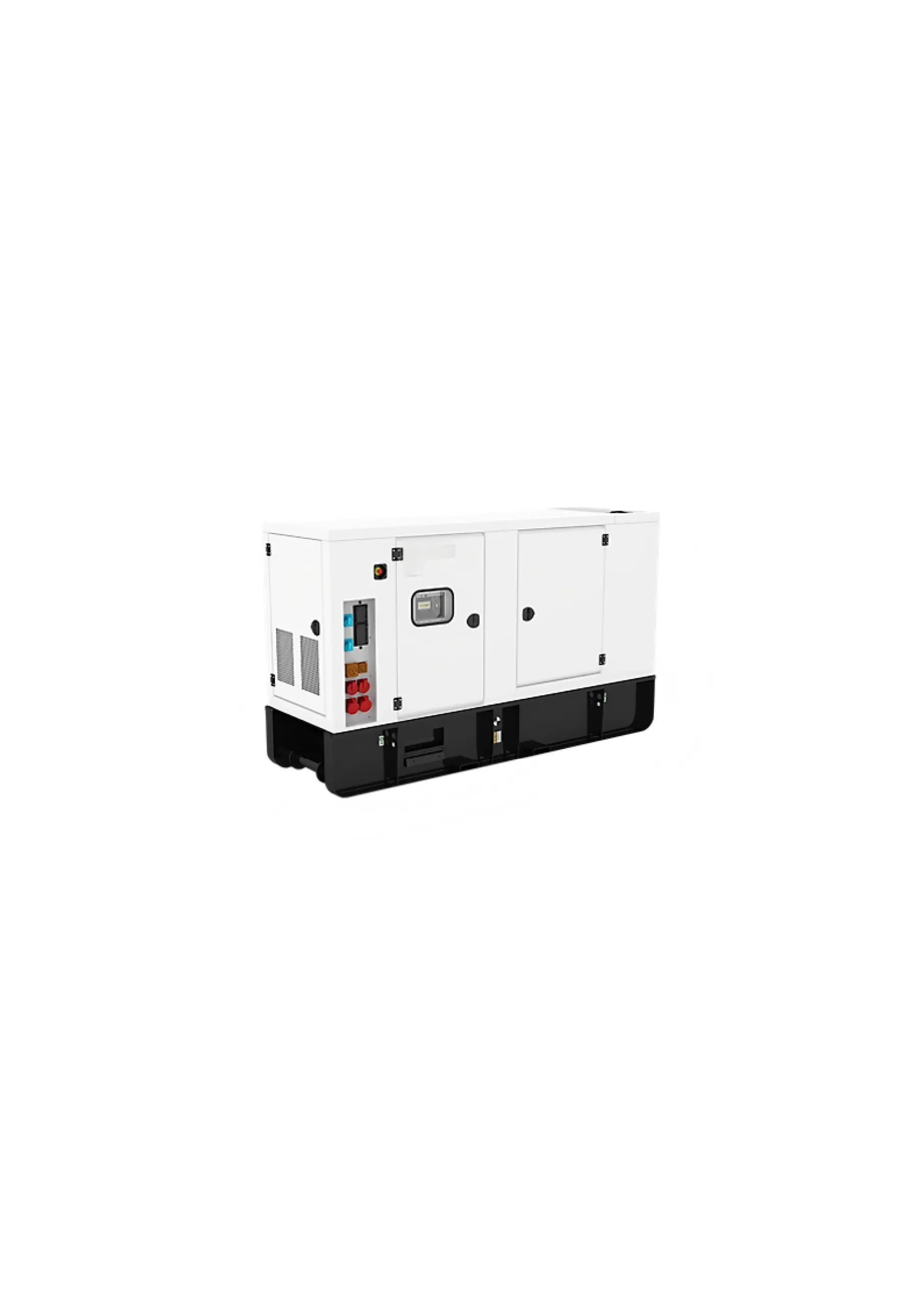
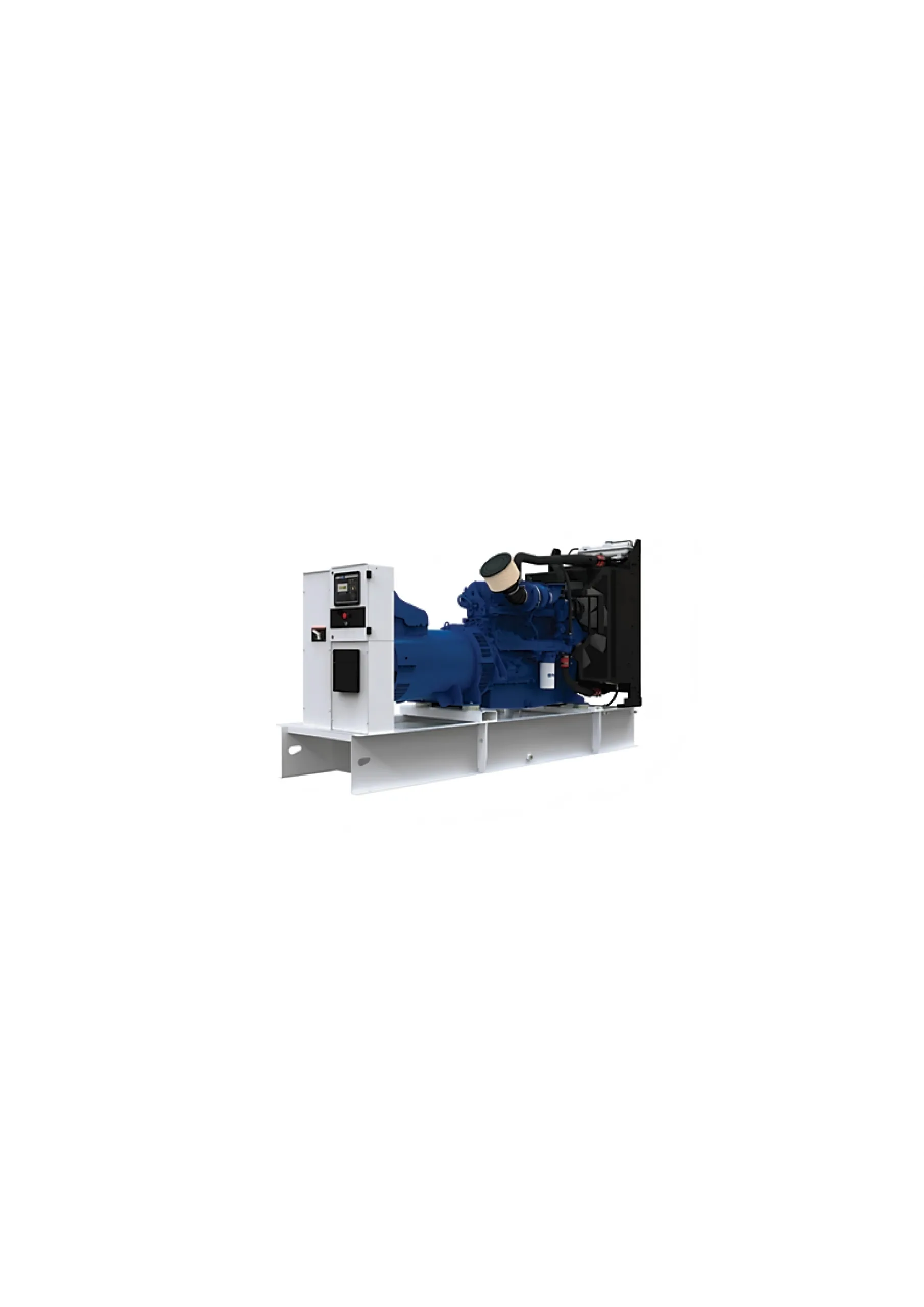
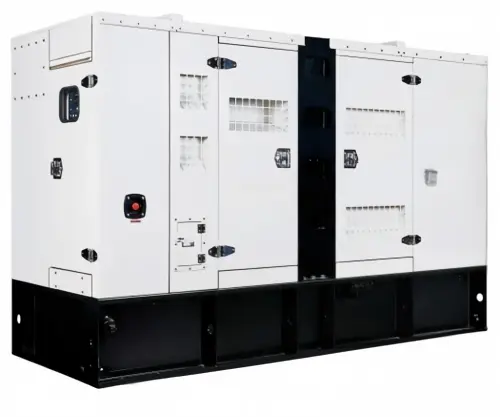
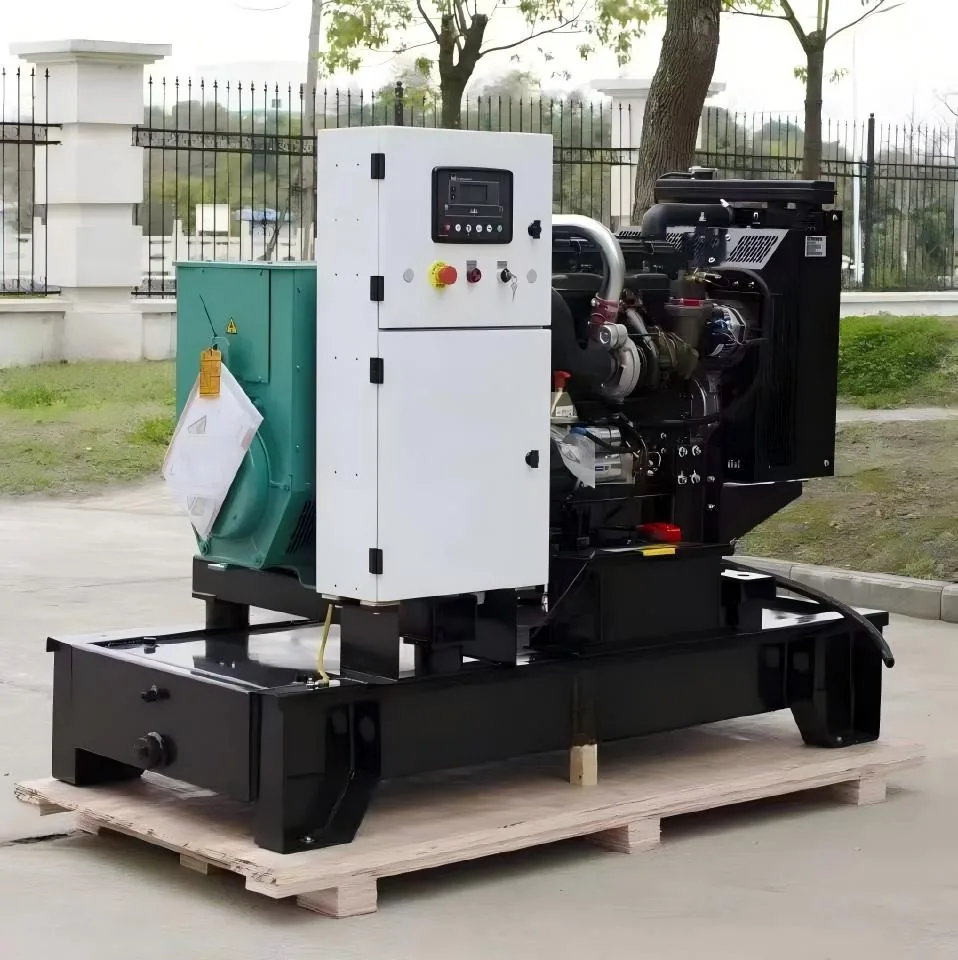
Canopy and noise. The open skid build is the machine on a base frame with the radiator exposed, suitable for a plant room or a covered compound. The soundproofed canopy drops the one-metre level to roughly 68 to 72 dB(A) and is the version most export buyers take, because it also weatherproofs the set and lets it stand outdoors. Containerised and trailer-mounted builds use the same core machine with a different envelope, so the electrical data on this page holds across all four.
Fuel and runtime. At full load the engine burns about 4.0 L/h, at 75 per cent about 3.2 L/h and at half load about 2.7 L/h. The litres-per-kWh figure is worst at part load (0.42 L/kWh at half load against 0.31 at full load), which is the counter-intuitive part of sizing: a set run at half load burns more fuel per unit delivered than the same set run hard. On a 50 L base-frame tank that works out to roughly 15 hours at 75 per cent load, and on a 100 L tank roughly double. For anything above eight hours of continuous running, plan a bulk tank with a day tank and a transfer pump rather than relying on the base frame.
Where this rating actually fits. A 13 kW three-phase set is the entry point for light industrial and commercial standby: a workshop with a few machines, a cold store, a small hotel, a telecom site, a water treatment pump set. Three phase at this rating means motors start properly and the cable is a third of the copper of the single-phase equivalent. The constraint is balance: keep the phase-to-phase imbalance under 20 per cent, because an unbalanced load derates the alternator faster than an overload does.
Parallel operation and transfer. Below about 30 kVA, paralleling is rarely worth the control complexity: two sets need load-sharing governors, synchronising hardware and a common switchgear panel, and the cost of that exceeds the cost of simply buying one larger set. What this rating does need is a proper transfer arrangement: a manual changeover switch if the site is attended, an automatic transfer switch with a mains-failure sensor if it is not. The set itself accepts a remote start signal on a two-wire dry contact, which is all an ATS needs.
Maintenance that actually gets done. Oil and oil filter at 250 hours or annually, whichever comes first; fuel filter and air filter at 500 hours; coolant condition checked annually and changed at two years; valve clearance checked at 1,000 hours. The item most often skipped is the load bank test: a set that runs monthly on a light load will wet-stack and glaze the bores, and the first time it sees a real load it will smoke and under-perform. Run it at 75 per cent load for an hour every quarter, and record the exhaust temperature, because that is the number that tells you the engine is healthy.
Sizing it against a construction site. Site power is a moving target: the set is asked to run lighting, a site office, small tools, a welder and a concrete vibrator, and the mix changes weekly. A 16 kVA set gives enough headroom for that kind of growth, and the practical requirement is not precision but robustness: a set that will accept a 30 per cent overload for a few seconds without tripping, and a canopy that survives being moved on a trailer. At this rating the trailer-mounted build is usually the right answer, because a site set spends more time being relocated than running. Fuel theft and fuel quality are the two failure modes that actually take site sets out of service, so a lockable tank and a water-separating pre-filter earn their cost quickly.
The foundation and vibration. A 16 kVA set weighs enough that it will walk on a bad base. On an open skid the frame sits on anti-vibration mounts, and those mounts only work if the surface underneath is flat and rigid: a concrete plinth at least 150 mm thick, level to within a few millimetres across the skid length, with the mounts bearing evenly. On a canopy build the same applies to the canopy feet. If the set is going on a steel deck or a roof, add a spreader frame rather than bolting straight through the deck plate, because the vibration will crack the plate at the bolt holes long before the mounts fail. Check the mounts at every service: a collapsed mount shows up as a rumble at the alternator end and eventually as a cracked exhaust.
Exhaust leaks and the silent ones. A leaking exhaust manifold gasket is loud and obvious. A leaking after-treatment bellows or a cracked flex section can be quiet and still lethal, because carbon monoxide has no smell and the leak is often on the underside where nobody looks. Inspect the whole exhaust path at every annual service, including the parts inside the canopy, and look for black soot streaks at joints, which are the signature of a leak. On a set installed indoors, fit a carbon monoxide alarm in the plant room regardless of how good the exhaust looks.
The spare parts kit that pays for itself. For a set in a remote location, the difference between a two-day repair and a two-month repair is a box of parts. The kit worth carrying at this rating is small: a set of fuel, oil and air filters, a fan belt, a water pump seal, a thermostat, an AVR, a set of sensors for oil pressure and coolant temperature, and a spare controller if the site cannot tolerate a wait. That kit costs a fraction of the set and it converts the most common failures from procurement events into maintenance events. It also removes the temptation to run a failing set because the part has not arrived.
Lubrication and oil analysis. The engine carries a full-flow oil filter and a sump of a few litres, and the service interval is 250 hours or annually, whichever comes first. The annual clause matters more than the hours on a standby set, because oil that sits in a sump for a year absorbs moisture and its additive package depletes regardless of run time. Beyond the interval, oil analysis is the cheapest diagnostic available: a sample at each service shows fuel dilution, which is the signature of wet stacking; coolant, which points at a head gasket or a liner seal; and wear metals, which track bearing and ring condition. A single sample is a snapshot; a trend over four services tells you whether the engine is healthy, and it costs less than the oil.
Where it sits in the range. Within the same Kohler-SDMO, K three-phase family at 50 Hz , one step down is the K12U II at 12 kW / 15 kVA, and one step up is the K16U IV at 16 kW / 20 kVA. The step between frames is a different engine displacement and a different alternator core, not a re-rated plate, so the price step is real rather than administrative.
How to order it. Quote five things together and the factory cannot get it wrong: the model (K16H II), the standby and prime rating, the voltage and frequency (400 V, 50 Hz), the phase (three phase), and the enclosure (open skid, soundproofed canopy, containerised or trailer). Add the emission tier if the destination is regulated. Anything else, including the controller variant, the alternator brand and the fuel tank size, is a build option rather than a different machine.
Standby output is 13 kW / 16 kVA (ESP), prime output is 11 kW / 14 kVA (PRP). The standby (ESP) figure is the maximum the set can carry for the duration of a mains failure and is not meant for continuous running. The prime (PRP) figure is what it can hold indefinitely at a varying load. Match the rating to the duty the set will actually see — running a standby-rated machine as prime voids the warranty.
The K16H II is wound for 400 V, 50 Hz, three phase, 4-wire (star), running at 1500 rpm. Voltage and frequency are fixed when the set is built, so confirm the site supply before the order is released. Other voltages and both 50 Hz and 60 Hz builds are available on the same frame.
The K16H II is powered by a Kohler-SDMO diesel engine. Engine and alternator are matched on the test bed, so the set reaches its rating without derating.
Fuel consumption is 4.0 L/h (0.31 L/kWh) at 100% load, 3.2 L/h at 75% load and 2.7 L/h at 50% load. These are measured figures on the standard build at those load points; real consumption shifts with load profile, ambient temperature and fuel quality. Send the expected daily running hours and average load if you want a duty-cycle estimate.
Runtime is 15 hours on a 50 L base tank. Tank capacity can be increased on request, and runtime scales directly with it against the consumption figures above.
Sound pressure is 68-72 dB(A) @ 1 m on the soundproofed build. An open skid set is considerably louder and needs either an acoustic canopy or a separate plant room to meet site noise limits.
The K16H II is available as open skid, weatherproof silent canopy, containerised or mobile trailer. Enclosure choice changes footprint, weight, noise level and price, so specify it with the enquiry and the quotation will match the build.
The K16H II ships with an automatic panel, manual/auto selector, LCD metering, RS485 Modbus and a brushless synchronous, 4-pole, single bearing, direct coupled alternator. Both are build options — alternative controllers and alternator makes can be specified when the order is placed.
On this set, voltage is held by an AVR, +/- 1% steady state, THD < 3% and the machine is built with Class H insulation, IP23 protection. That grade of regulation suits motors, pumps and most electronic loads; for sensitive IT or medical equipment, specify the higher-grade controller option.
The controller trips on over-speed, low oil pressure, high coolant temperature, over/under voltage, over/under frequency, over-current, phase sequence. These shutdowns stop the set before damage occurs, which is what makes an unattended standby installation safe to leave running.
Warranty is 2 years or 2,000 hours, international coverage. It applies to the set as configured — running outside the rated duty, using non-specified fuel or skipping scheduled service will void it.
Send the model (K16H II), the duty (standby or prime), voltage and frequency, phase, and the enclosure type you need. Jinjia Power quotes against a confirmed configuration rather than a list price, so the figure you receive matches the machine that ships. Typical lead time is 20–30 days for units up to 1000 kW and 30–45 days above that.
Jinjia Power Equipment Co., Ltd | Address: No.737, Guanzhang Road, Liaobu Town, Dongguan, China
Phone: 86-13553838770 | 86-0769-89610677 | info@jinjiadongli.com
Jinjia Power, Quality Assured