Product Overview
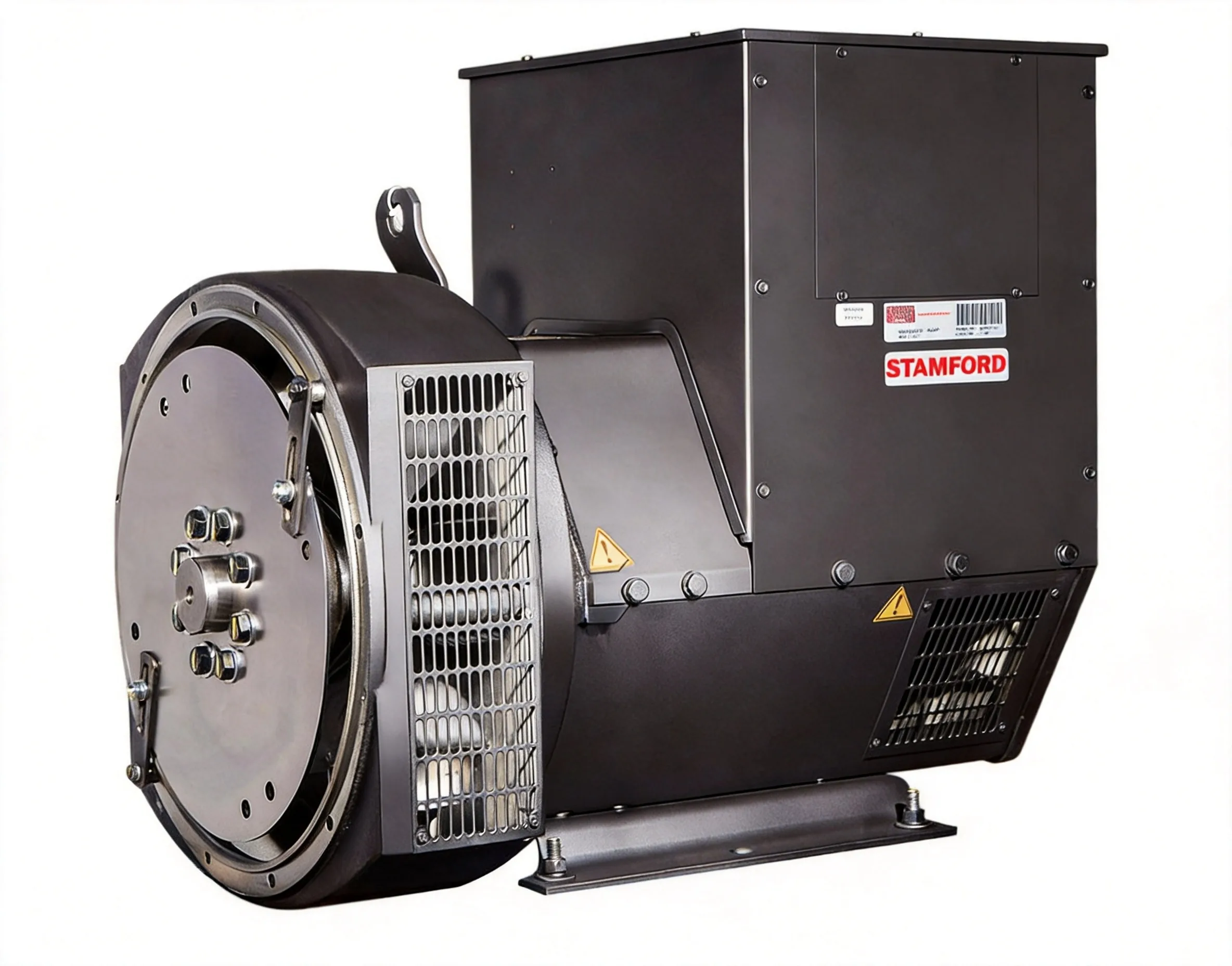
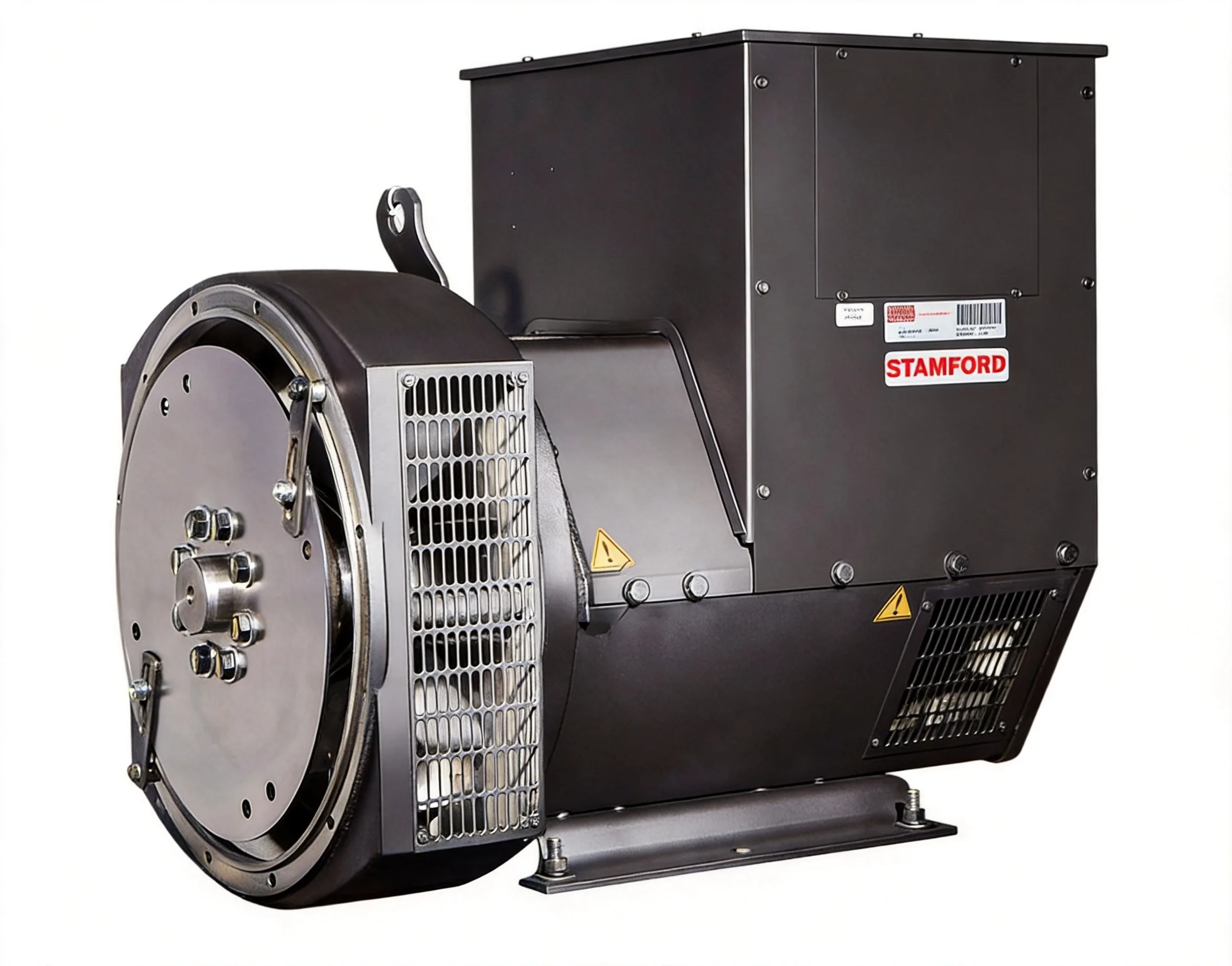
Model. The UCI224D2 is a Stamford UCI 4-pole alternator. Stamford designates the frame by the number in the model (224) and the core length by the letter that follows it (D). Within one frame the letter runs from short to long, and each step adds lamination stack and therefore output. The trailing digit is a winding or revision suffix, not a rating change. It is wound for three-phase service at 60 Hz. Electrical rating. At 0.8 power factor lagging this machine is rated 48 kW, which is 60 kVA, delivered as three-phase at 480 V 60 Hz. At 480 V line-to-line that is 72.2 A per line. Small frames like this are sensitive to load power factor: running them well below 0.8 PF pushes the field current up and the stator current up at the same kW, so the nameplate kVA is the number to design to. The 1800 rpm figure is synchronous speed, so there is no slip and no speed-dependent voltage droop. Frame and core. The 224 frame carries the D core. Frame size fixes the stator bore and the shaft centre height; the core length fixes how much active iron sits in that bore, and therefore how much output the machine can make at a given temperature rise. The exact finished weight and outline drawing depend on the winding and the coupling, so they are confirmed on the certified datasheet issued with the order. The cooling circuit is 0.617 m3/s (1308 cfm) at UCI274, and the frame is steel frame, cast iron end shields. Three-phase winding. This is a three-phase machine with a 12 re-connectable winding brought out to 12 re-connectable terminals, so it can be reconnected on site for the usual voltage pairs — 380/220 V, 400/230 V, 415/240 V, 440/254 V and 480/277 V on the 50 Hz build, and the 60 Hz pairs on the 60 Hz build. Reconnection is done on the link board inside the terminal box, not by rewinding, which is why one machine can serve a 380 V job and a 480 V job. The 2/3 pitch design is what keeps the fifth and seventh space harmonics down without skewing the stator, and it is the reason the line-to-line waveform stays within the distortion limits the standards ask for. Four-pole build. A four-pole machine turns at 1500 rpm on 50 Hz and 1800 rpm on 60 Hz. That is the standard choice for generator sets from a few tens of kVA up to the low megawatt range, because the lower rotor speed gives a longer bearing life, a quieter fan, a higher subtransient reactance that is easier to coordinate with downstream protection, and a rotor that can carry a substantial damper cage for parallel operation. The trade is weight: a four-pole machine of a given kVA is roughly twice the mass of a two-pole one. Excitation and voltage regulation. The excitation system is self-excited, brushless, rotating rectifier, regulated by MX321 (+/-0.5%) or MX341 (+/-1.0%), holding steady-state voltage to +/-0.5% (MX321) / +/-1.0% (MX341). The MX321 and MX341 regulators are the two standard AVRs on this frame. MX321 holds +/-0.5% and adds three-phase sensing plus over-excitation and under-excitation limiting; MX341 holds +/-1.0% with single-phase sensing and is the cheaper option where the load is well behaved. Both are fed from a separate auxiliary winding, so the excitation supply does not collapse when the main output is shorted — which is what gives the machine its three-times-full-load fault current for ten seconds. Mechanical build. The frame is steel frame, cast iron end shields. Bearings are BALL.6315-2RS drive end / BALL.6310-2RS non-drive end (UCI274). Mounting is single bearing SAE flange or two bearing, IM 1201 / IM 1001. Maximum overspeed is 2250 rpm, and the machine is rated for 1000 m; derate 3% per 500 m above. The stator winding is double-layer concentric, and the rotor is balanced to better than BS6861 Part 1 Grade 2.5, which is what keeps vibration low enough for a set that will sit on a skid in a plant room. Derating for a dirty environment is 5% with an inlet filter fitted, 3% per 500 m above 1,000 m, and 3% per 5 degrees C above 40 degrees C ambient. Where it fits. Light commercial duty: a retail unit, a small workshop, a guesthouse, or a farm with an irrigation pump. Loads are mostly resistive and lightly inductive, so a standard shunt-excited machine copes without a PMG. On a three-phase machine of 48 kW the practical constraint is usually the downstream protection and the cable, not the alternator itself. Core stack position. The D core is stack position 2 of 5 in the UCI family, roughly 40% of the way along the family's lamination length range. It sits between the shorter C and the longer E. Mid-stack builds are the general-purpose choice. The lamination length is long enough to hold flux density at a moderate level and keep efficiency up at part load, while the machine still fits a standard skid or an ISO 20 ft container footprint without a custom base frame. Where it sits in the range. The UCI family is catalogued from 32 kW up to 1250 kW, and this page covers the 48 kW / 60 kVA point. The step below it is the UCI224D 3-Phase at 40 kW, 50 kVA. The step above it is the UCI224F 3-Phase at 56 kW, 70 kVA. If your load sits between two steps, take the higher one and let the engine run at part load rather than pushing the smaller machine to its limit on a hot afternoon. Reading the model code. A Stamford designation is read as the family letters (UCI, UCDI, HCI, PI, LVSI), a three-digit frame number, a core letter, and an optional winding suffix. Here that gives UCI224D2 for the model, 224 for the frame, D for the core and three for the phase count, so the code on the nameplate and the code on this page match one for one. Quoting the full code rather than just the frame matters on this family, because the same frame number is built in several core lengths and the winding changes with the voltage. Frame position. The UCI range is built on 3 frame sizes — 224, 274, 634 — and the 224 frame is number 1 of them. No other frame in this range carries exactly this rating, so the 224 is the only build at 48 kW and there is no cross-frame decision to make. What the nameplate means once it is wired in. At 48 kW and 60 kVA this machine pushes 72 A down each line on a 480 V three-phase supply. That current, not the kVA figure, is what the switchgear and the cable have to survive, so the outgoing breaker should be a 100 A frame device set to trip above 90 A, and the run from the alternator terminals to the first panel should be 25 mm2 copper per phase for a normal 25 to 30 m span. Longer runs, aluminium conductors or tray-installed cable all move that number up, and the volt drop at full load is what decides it in the end. On the mechanical side the prime mover has to deliver about 53.8 kW at the coupling. The usual 1.10 to 1.15 margin over the alternator rating covers the fan, the excitation loss and the governor droop, and it is the reason a 48 kW alternator is normally quoted against a 53.8 kW engine rather than a 48 kW one. Fuel burn follows the electrical load almost linearly in this range. At a realistic 0.29 L per kWh for a modern common-rail set, running this alternator at full rating takes roughly 14 L per hour; at 75 per cent load it drops to about 11 L per hour and at half load to about 8 L per hour, because the fixed losses stay put while the variable ones fall away. Quote the breaker frame, the cable size and the engine rating together with the alternator, because a set that is right on paper and undersized on the cable is the most common way a good alternator gets blamed for a bad installation. Where this rating sits in the frame ladder. Within the 224 frame UCI carries 4 distinct ratings, and this is number 2 of them at 48 kW. The step below is the UCI224C2 at 38.4 kW / 48 kVA, 9.6 kW under this one; the step above is the UCI224E2 at 57.6 kW / 72 kVA, 9.6 kW over it. Every step inside one frame is one more lamination stack length. The shaft, the bearings, the foot pattern, the terminal box and the AVR are the same part across the whole ladder, and only the core length and the winding change. That is why the price gap between two neighbouring steps is small while the gap between the last step of one frame and the first step of the next is large. It also sets the value-engineering rule: dropping one core size inside the frame saves money and axial length but eats the margin to the load, while stepping up one size costs far less than jumping to the next frame and buying a bigger skid, a bigger breaker and a bigger cable with it. Supply. Supplied as a genuine Stamford unit — Cummins Generator Technologies, built in United Kingdom. the Stamford mark is owned by Cummins Generator Technologies and the machines are built in their own plants. Each alternator ships with the routine test certificate, the winding connection diagram, and the AVR commissioning sheet. Export packing is seaworthy plywood on a pallet sized to the frame, and the machine is strapped and shrink-wrapped inside it. Tell us the engine make and model, the coupling arrangement (single or two bearing), the voltage and frequency, and whether you need a PMG, and we will confirm the build before it leaves the works.