86-0769-89610677 / 86-13553838770 | info@jinjiadongli.com
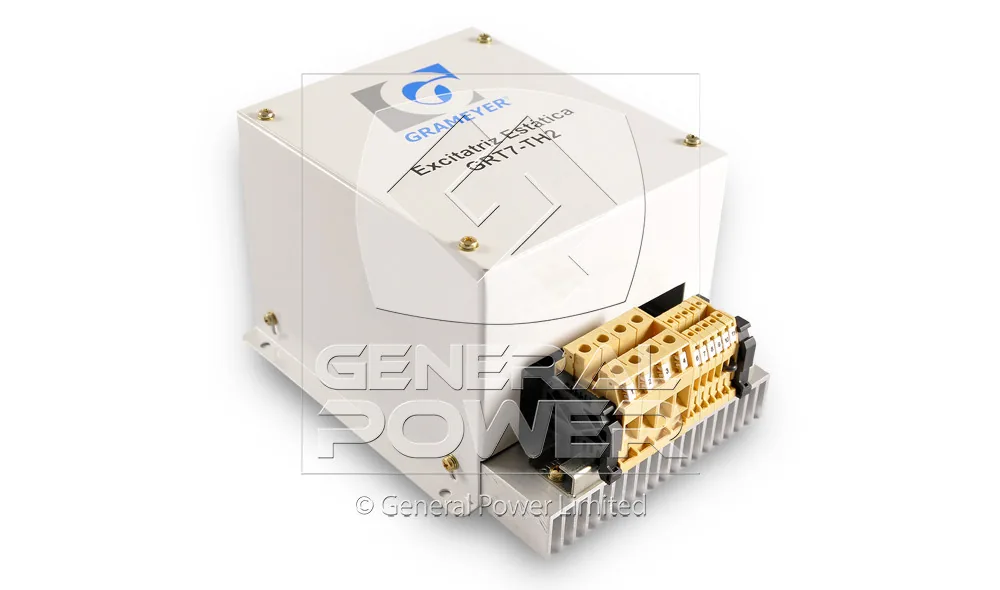
Status: IN STOCK, Same day shipping Worldwide available | Brand New, 1 Year International Warranty
* Contact us for pricing and full specifications
| SKU | GRT7-TH2 35A |
| Brand | GRAMEYER |
| Model Number | GRT7-TH2 35A |
| Regulator Type | Analogue Automatic Voltage Regulator |
| Excitation System | Self-excited, shunt fed |
| Sensing Input | Single-phase sensing, 160-300 Vac or 320-600 Vac |
| Power Input | 170-300 Vac single-phase or two-phase, 50 / 60 Hz |
| Output Voltage | 76.5-126 Vdc |
| Continuous Field Current | 35 A continuous |
| Forcing Current | 49 A for 10 s |
| Field Resistance (Min) | 6-50 ohm |
| Regulation Accuracy | 0.5 per cent static |
| Response Time | Adjustable from 8 to 500 ms |
| Frequency Range | 50 / 60 Hz |
| Under-Frequency Protection | Adjustable under-frequency protection |
| Voltage Adjustment | Internal trim potentiometer |
| Paralleling / Droop | Reactive droop for parallel operation |
| Build-Up Voltage | Builds up from residual voltage |
| Thermal Drift | Low thermal drift |
| Operating Temperature | -20 to +60 degC |
| Storage Temperature | -40 to +85 degC |
| Protection Features | Under-frequency, over-excitation |
| Compatible Alternators | Mid and large frame alternators |
| Mounting | Panel or terminal-box mount |
| Lifecycle Status | In production |
| Availability | IN STOCK, Same day shipping Worldwide available |
| Condition | Brand New, 1 Year International Warranty |
| Warranty | 1 Year International Warranty |
GRAMEYER GRT7-TH2 35A. This is a Analogue Automatic Voltage Regulator from the GRAMEYER range, supplied as a direct replacement for the same model number in the field. The figures that matter are printed in the table above and repeated here so the page can be read on its own: field current rating 35 A continuous, field resistance window 6-50 ohm, accuracy 0.5 per cent, working range -20 to +60 degC. Everything else on this page exists to explain how those four numbers decide whether the unit fits a particular alternator.
Excitation architecture. Self-excited, shunt fed. That single sentence decides most of the regulator's behaviour in a fault: whether the field survives a close-up short circuit, whether the machine builds up from residual voltage on its own, and how much the terminal voltage dips when a large motor starts on the same bus. Conformal coating is the difference between a board that survives a coastal site and one that corrodes quietly in eighteen months.
Sensing. Single-phase sensing, 160-300 Vac or 320-600 Vac. The sensing circuit is the regulator's only view of the outside world, so its wiring matters as much as its specification. A voltage error introduced by a loose terminal or a long run of untwisted cable is indistinguishable, from the regulator's point of view, from a genuine voltage error on the alternator. Terminal boxes are hot, dirty and vibrating. Anything mounted inside one should be judged on how it behaves in year eight, not on how it reads on the bench.
Power stage and field drive. Power input 170-300 Vac single-phase or two-phase, 50 / 60 Hz, output 76.5-126 Vdc. Field current rating 35 A continuous, forcing capability 49 A for 10 s, field resistance window 6-50 ohm. These are not independent numbers: the output voltage ceiling and the field resistance together set the maximum current the board can actually deliver, and the continuous rating is only reachable at the low end of the resistance window. An alternator that has been rewound needs its field resistance re-measured, because a rewind commonly moves it by ten to twenty per cent in either direction.
Accuracy and response. 0.5 per cent steady-state accuracy, Adjustable from 8 to 500 ms, thermal drift Low thermal drift. In practice the accuracy figure is the least interesting of the three. What an operator notices is recovery after a load step, which is governed by response and by available forcing current, and what a maintenance engineer notices after two years is drift, which is governed by the reference circuit and the ambient temperature inside the terminal box. Static accuracy is measured on a resistive load at constant frequency. Real loads and real governors are neither, so treat the figure as a comparison between boards rather than a promise.
Frequency behaviour. Rated for 50 / 60 Hz, with Adjustable under-frequency protection. The frequency-sensitive function exists to protect the prime mover, not the alternator: as engine speed falls the regulator reduces excitation so the alternator stops demanding torque the engine cannot supply. Without it, an overloaded engine is dragged down until it stalls, and the alternator is blamed for a fault that belongs to the fuel or governor system. The trim potentiometer is not a calibration device. If rated voltage is not reachable near the middle of its range, the sensing tap is wrong.
Paralleling. Reactive droop for parallel operation. On a single set this circuit does nothing. On two or more sets it is the only thing that stops the machines from exchanging reactive power in a slow oscillation, and it is the first place to look when a parallel installation shows a circulating current that nobody can explain. An alternator that has been rewound needs its field resistance re-measured, because a rewind commonly moves it by ten to twenty per cent in either direction.
Protection built into the regulator. Under-frequency, over-excitation. These functions protect the alternator and the regulator, not the installation. Downstream protection, loss of mains and reverse power all belong to the controller, and a site that relies on the AVR for them is a site that will eventually trip in a way nobody can explain. An alternator that has been rewound needs its field resistance re-measured, because a rewind commonly moves it by ten to twenty per cent in either direction.
What it fits. Mid and large frame alternators. Lifecycle status: In production. Both halves of that sentence matter at order time. A board that fits perfectly but has been discontinued is a different commercial decision from one that fits and is in current production, and the price difference rarely reflects the difference in risk. Load sharing between parallel sets is set up with an instrument, not by ear. A droop adjustment made by listening to the sets will be wrong at every load other than the one it was set at.
Field notes on this model. The GRT7-TH2 is the higher-current companion to the TH4. The suffix after TH2 is the rated field current, so a TH2-35A is built to hold 35 A continuously, which means a different power stage rather than a relabelled board. These are used on large frame alternators where a TH4 would run out of field current on a cold load step.
Standby versus prime power. A standby set runs a few hundred hours a year and its regulator spends most of its life cold; a prime power set runs continuously and its regulator spends its life at operating temperature. The GRT7-TH2 35A is rated for -20 to +60 degC, which is fine in both cases provided the terminal box has any ventilation at all. What changes between the two duties is the capacitor ageing inside the board, not the semiconductor, so a prime power machine should have the regulator inspected on a schedule rather than on failure.
Fusing. Fit the fuse the manual specifies and nothing larger. A bigger fuse does not protect the regulator better, it protects it later. On a GRT7-TH2 35A the fuse is there to clear a field short before the thyristor is destroyed, and a 20 A fuse in place of an 8 A one turns a cheap board replacement into a rewind.
Stability before accuracy. Set the stability adjustment until the voltage stops hunting on a load step, then leave it alone. Chasing the last tenth of a per cent of static accuracy by tightening stability is how a set ends up oscillating at 2 Hz under a resistive load and looking like a governor fault. The GRT7-TH2 35A is specified at 0.5 per cent static; a real machine on a real load will not do better than that no matter how the trimmer is set.
Series resistance is not a fix. Adding a resistor in series with the field to bring it inside a regulator window costs forcing current exactly when the machine needs it most. If the field resistance is outside the window, change the board, not the circuit.
Voltage high and unresponsive. If the machine runs to maximum excitation regardless of the trim, disconnect the field and see whether the voltage collapses. If it does, the regulator has failed shorted; if it does not, the field is being fed from somewhere else, usually a shorted thyristor or a mis-wired paralleling circuit. Do not run the machine at full excitation for more than a few seconds while diagnosing, because the winding will not survive it.
Warranty and what it covers. A one year warranty on a regulator is meaningful only if it covers a field-side failure and not just a dead-on-arrival check. Ask whether a board that fails after six months in service is replaced without argument, because that is the failure mode that actually happens.
Matching the board to the duty, not to the label. Two GRAMEYER alternators of the same kVA can need different regulators if one is specified for motor starting and the other for a resistive load. The GRT7-TH2 35A is specified at 0.5 per cent static regulation accuracy, which is the number that matters when the load is a mix of drives and lighting. For a purely resistive load even a looser board is invisible to the customer, and paying for accuracy that nobody measures is the most common way money is wasted on a rebuild.
Power and sensing are not the same circuit. The power input on a GRT7-TH2 35A can come from a different winding from the sensing input, and on PMG machines it always does. Wire them as two separate circuits, fused separately, and label both. The single most expensive mistake on a PMG set is landing the sensing leads on the PMG supply, which gives the regulator a voltage reference that rises with speed and produces a set whose voltage tracks engine rpm.
Jinjia Power Equipment Co., Ltd | Address: No.737, Guanzhang Road, Liaobu Town, Dongguan, China
Phone: 86-13553838770 | 86-0769-89610677 | info@jinjiadongli.com
Jinjia Power, Quality Assured