86-0769-89610677 / 86-13553838770 | info@jinjiadongli.com

Status: IN STOCK, Same day shipping Worldwide available | Brand New, 1 Year International Warranty
* Contact us for pricing and full specifications
| SKU | M63FA310A |
| Brand | MARELLI |
| Model Number | M63FA310A |
| Regulator Type | Analogue Automatic Voltage Regulator, Mark X platform |
| Excitation System | PMG fed, designed for Marelli MJB alternators with a permanent magnet pilot exciter |
| Sensing Input | Single-phase, 170-480 Vac, 50 / 60 Hz, +/-10 per cent tolerance |
| Power Input | Auxiliary winding or main terminals, 170-277 Vac at 100 / 120 Hz, +/-10 per cent |
| Output Voltage | 100 Vdc maximum |
| Continuous Field Current | 8 Adc continuous |
| Forcing Current | 15 Adc for 1 minute |
| Field Resistance (Min) | 3-20 ohm, or 3.5-20 ohm on some builds |
| Regulation Accuracy | +/-0.5 per cent from no load to full load at 0.8 power factor on balanced undistorted load at constant frequency. Steady-state accuracy +/-0.1 per cent, or +/-1 per cent with 4 per cent engine governing |
| Response Time | One cycle |
| Frequency Range | 50 / 60 Hz |
| Under-Frequency Protection | Under-frequency limiter with an adjustable knee |
| Voltage Adjustment | A 100 kohm external potentiometer gives +/-5 per cent of rated voltage, and an external DC signal of -3 / +3 V suits a power factor controller |
| Paralleling / Droop | Reactive droop compensation, +/-20 per cent |
| Build-Up Voltage | Builds up from 5 Vac residual |
| Thermal Drift | +/-0.5 per cent for a 50 degC ambient change after a 10 minute warm-up |
| Operating Temperature | -30 to +70 degC |
| Storage Temperature | -40 to +80 degC |
| Protection Features | Under-frequency limiter, over-excitation limiter, internally replaceable fuse |
| Compatible Alternators | Marelli MJB 225-500 frame alternators |
| Mounting | Panel or terminal-box mount |
| Lifecycle Status | In production |
| Availability | IN STOCK, Same day shipping Worldwide available |
| Condition | Brand New, 1 Year International Warranty |
| Warranty | 1 Year International Warranty |
What the M63FA310A is. A Analogue Automatic Voltage Regulator, Mark X platform built by MARELLI for brushless excitation systems. On paper the specification is a list; in service it is a set of limits. The current the board will hold indefinitely is 8 Adc continuous; the field resistance window it will drive without exceeding its output voltage is 3-20 ohm; the tightest voltage band it can maintain is +/-0.5 per cent; and the ambient range in which all of that remains true is -30 to +70 degC.
Excitation architecture. PMG fed, designed for Marelli MJB alternators with a permanent magnet pilot exciter. That single sentence decides most of the regulator's behaviour in a fault: whether the field survives a close-up short circuit, whether the machine builds up from residual voltage on its own, and how much the terminal voltage dips when a large motor starts on the same bus. On a machine that has been standing for months, check residual voltage before condemning anything: a winding that has lost its remanence will not build up on any regulator.
Sensing. Single-phase, 170-480 Vac, 50 / 60 Hz, +/-10 per cent tolerance. The sensing circuit is the regulator's only view of the outside world, so its wiring matters as much as its specification. A voltage error introduced by a loose terminal or a long run of untwisted cable is indistinguishable, from the regulator's point of view, from a genuine voltage error on the alternator. Take a photograph of the terminal block before removing anything. Wiring drawings for older machines are frequently wrong, and the photograph is the only reliable record.
Power stage and field drive. Power input Auxiliary winding or main terminals, 170-277 Vac at 100 / 120 Hz, +/-10 per cent, output 100 Vdc maximum. Field current rating 8 Adc continuous, forcing capability 15 Adc for 1 minute, field resistance window 3-20 ohm. These are not independent numbers: the output voltage ceiling and the field resistance together set the maximum current the board can actually deliver, and the continuous rating is only reachable at the low end of the resistance window. The most common cause of intermittent excitation loss is a crimp terminal that was never properly made. Wiggle the harness with the machine running before replacing anything.
Accuracy and response. +/-0.5 per cent steady-state accuracy, One cycle, thermal drift +/-0.5 per cent for a 50 degC ambient change after a 10 minute warm-up. In practice the accuracy figure is the least interesting of the three. What an operator notices is recovery after a load step, which is governed by response and by available forcing current, and what a maintenance engineer notices after two years is drift, which is governed by the reference circuit and the ambient temperature inside the terminal box. Take a photograph of the terminal block before removing anything. Wiring drawings for older machines are frequently wrong, and the photograph is the only reliable record.
Frequency behaviour. Rated for 50 / 60 Hz, with Under-frequency limiter with an adjustable knee. The frequency-sensitive function exists to protect the prime mover, not the alternator: as engine speed falls the regulator reduces excitation so the alternator stops demanding torque the engine cannot supply. Without it, an overloaded engine is dragged down until it stalls, and the alternator is blamed for a fault that belongs to the fuel or governor system. Where a board has been superseded, the replacement usually fits the same footprint but not the same terminal numbering. Read the drawing, do not read the old wiring.
Paralleling. Reactive droop compensation, +/-20 per cent. On a single set this circuit does nothing. On two or more sets it is the only thing that stops the machines from exchanging reactive power in a slow oscillation, and it is the first place to look when a parallel installation shows a circulating current that nobody can explain. Terminal boxes are hot, dirty and vibrating. Anything mounted inside one should be judged on how it behaves in year eight, not on how it reads on the bench.
Protection built into the regulator. Under-frequency limiter, over-excitation limiter, internally replaceable fuse. These functions protect the alternator and the regulator, not the installation. Downstream protection, loss of mains and reverse power all belong to the controller, and a site that relies on the AVR for them is a site that will eventually trip in a way nobody can explain. The trim potentiometer is not a calibration device. If rated voltage is not reachable near the middle of its range, the sensing tap is wrong.
What it fits. Marelli MJB 225-500 frame alternators. Lifecycle status: In production. Both halves of that sentence matter at order time. A board that fits perfectly but has been discontinued is a different commercial decision from one that fits and is in current production, and the price difference rarely reflects the difference in risk. If two identical sets behave differently on the same load, swap the regulators before swapping anything else. The result tells you which side of the machine the fault is on.
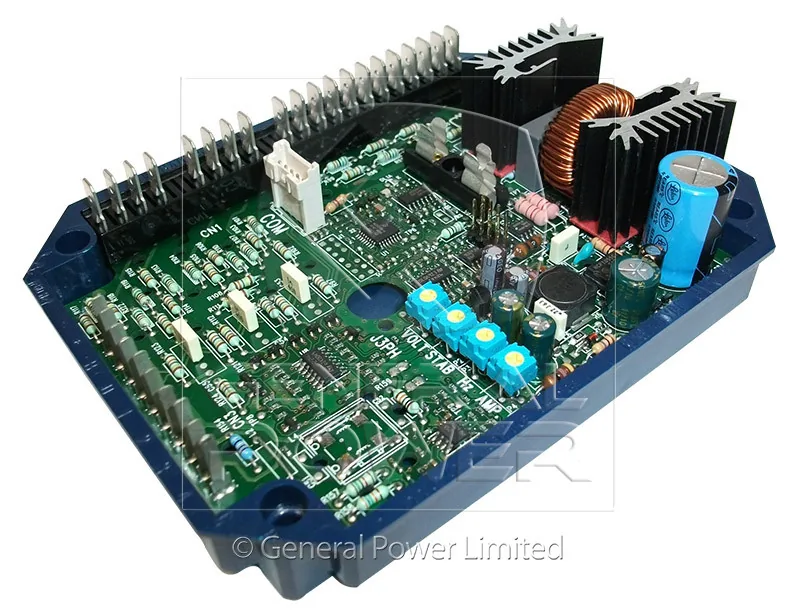
Field notes on this model. The Mark X is fully resin-encapsulated, which is what makes it survive humidity, conductive dust, salt spray and the vibration of a marine or offshore installation. It is designed around a PMG, so excitation holds up through a short circuit. Marelli also publishes the external control interface: a 100 kohm potentiometer gives +/-5 per cent voltage trim, and a -3 / +3 V DC signal lets a power factor controller drive it directly.
Reading the application backwards. Most regulator problems arrive described as engine trouble. A set that hunts on load, or whose voltage sags for two seconds after a contactor closes, is usually reporting a field current limit rather than a fuel problem. On a M63FA310A the first thing to check is whether the 8 Adc continuous figure is being reached on a cold morning, because field resistance rises with temperature in the opposite direction to copper and a board that is marginal at 20 degC can be comfortable at 50 degC or the other way round depending on the winding.
Earthing and shielding. The regulator reference is the machine frame. Bond the AVR mounting plate to the frame with a dedicated conductor rather than relying on the mounting screws, and earth the sensing cable shield at one end only. When a set shows a voltage that wanders slowly with no load change, the cause is usually a circulating current in the shield rather than a failing board.
Paralleling setup. With two sets on the bus, adjust droop until reactive load divides in proportion to machine rating, then check it again at half load. A droop setting that looks right at full load and wrong at half load is usually a CT ratio error rather than a regulator fault.
The forcing margin. A regulator that can only just hold rated voltage at rated load has no forcing margin left, and the machine will dip on every load step. The M63FA310A is specified with a minimum field resistance of 3-20 ohm, or 3.5-20 ohm on some builds; staying comfortably above that minimum, rather than exactly at it, is what leaves the forcing margin that makes a set feel solid rather than merely adequate.
Intermittent loss of excitation. Intermittent faults are almost always mechanical: a crimp that was never properly made, a terminal screw that was tightened onto insulation, or a board that is flexing. Wiggle-test the harness with the machine running at no load and watch the field current meter.
Documentation. Insist on the wiring drawing for the exact suffix being supplied. Generic family drawings are the reason installations end up with the sensing on the wrong tap, and the resulting fault is indistinguishable from a faulty board.
Where this board earns its place. The M63FA310A is normally the answer when a MARELLI machine has lost regulation and the original board is either unavailable or priced like a small car. What decides the fit is not the brand name on the cover but three numbers: the field resistance window, the continuous field current, and the sensing voltage the machine actually delivers at the AVR terminals. Get those three right and the regulator behaves; get any one of them wrong and the symptom usually looks like a mechanical fault rather than an electrical one.
Mounting orientation and cooling. Most AVR boards are convection cooled and assume the heatsink fins are vertical. Mounting a M63FA310A flat on its back inside a sealed box shortens its life even though the ambient temperature reads acceptable, because the local air around the thyristor is far hotter than the box average.
Jinjia Power Equipment Co., Ltd | Address: No.737, Guanzhang Road, Liaobu Town, Dongguan, China
Phone: 86-13553838770 | 86-0769-89610677 | info@jinjiadongli.com
Jinjia Power, Quality Assured