86-0769-89610677 / 86-13553838770 | info@jinjiadongli.com
Status: IN STOCK, Same day shipping Worldwide available | Brand New, 1 Year International Warranty
* Contact us for pricing and full specifications
| SKU | AVC63-4 |
| Brand | BASLER |
| Model Number | AVC63-4 |
| Regulator Type | Analogue Automatic Voltage Regulator |
| Excitation System | Self-excited, shunt or auxiliary-winding fed |
| Sensing Input | 190-264 Vac single-phase, 120 V and 240 V jumper selectable, 50 / 60 Hz |
| Power Input | 90-240 Vac single-phase |
| Output Voltage | 63 Vdc maximum at 240 Vac input, 32 Vdc at 120 Vac input |
| Continuous Field Current | 4 Adc continuous |
| Forcing Current | 8 Adc for 10 s |
| Field Resistance (Min) | 15 ohm minimum (10 ohm below 175 Vac input), 100 ohm maximum |
| Regulation Accuracy | +/-1.0 per cent over a 4 per cent engine speed change |
| Response Time | About 20 ms |
| Frequency Range | 50 / 60 Hz, jumper selected |
| Under-Frequency Protection | Roll-off knee 45-51 Hz on 50 Hz or 54-61 Hz on 60 Hz, with a U/F indicator |
| Voltage Adjustment | +/-10 to +/-15 per cent with a 1-2 kohm, 1 W potentiometer |
| Paralleling / Droop | Reactive droop via CT |
| Build-Up Voltage | Builds up from 5 Vac residual |
| Thermal Drift | 0.05 per cent per degC |
| Operating Temperature | -40 to +60 degC |
| Storage Temperature | -65 to +85 degC |
| Protection Features | Over-excitation shutdown, loss of sensing protection, integral high-breaking-capacity fuse |
| Compatible Alternators | Stamford, Leroy Somer, Marathon, Marelli and Mecc Alte alternators up to about 500 kVA |
| Mounting | Standard mounting holes for easy installation |
| Dimensions (L x W x H) | Approximately 4.5" x 2.5" x 1.5" |
| Weight | Approximately 0.5 lbs (0.23 kg) |
| Lifecycle Status | In production |
| Availability | IN STOCK, Same day shipping Worldwide available |
| Condition | Brand New, 1 Year International Warranty |
| Warranty | 1 Year International Warranty |
Short version. The AVC63-4 is a Analogue Automatic Voltage Regulator. It supplies the exciter field, senses the alternator output and corrects the difference several times a second. Its rating is 4 Adc continuous, its field resistance window 15 ohm (10 ohm below 175 Vac, its accuracy +/-1.0 per cent, and it is intended for machines whose field winding sits inside that window. Read the rest of this page as the detail behind those three figures.
Excitation architecture. Self-excited, shunt or auxiliary-winding fed. That single sentence decides most of the regulator's behaviour in a fault: whether the field survives a close-up short circuit, whether the machine builds up from residual voltage on its own, and how much the terminal voltage dips when a large motor starts on the same bus. On a machine that has been standing for months, check residual voltage before condemning anything: a winding that has lost its remanence will not build up on any regulator.
Sensing. 190-264 Vac single-phase, 120 V and 240 V jumper selectable, 50 / 60 Hz. The sensing circuit is the regulator's only view of the outside world, so its wiring matters as much as its specification. A voltage error introduced by a loose terminal or a long run of untwisted cable is indistinguishable, from the regulator's point of view, from a genuine voltage error on the alternator. If two identical sets behave differently on the same load, swap the regulators before swapping anything else. The result tells you which side of the machine the fault is on.
Power stage and field drive. Power input 90-240 Vac single-phase, output 63 Vdc maximum at 240 Vac input, 32 Vdc at 120 Vac input. Field current rating 4 Adc continuous, forcing capability 8 Adc for 10 s, field resistance window 15 ohm (10 ohm below 175 Vac. These are not independent numbers: the output voltage ceiling and the field resistance together set the maximum current the board can actually deliver, and the continuous rating is only reachable at the low end of the resistance window. The measurement that settles most arguments is the field current at full load, taken with a clamp meter, compared against the rating on the board.
Accuracy and response. +/-1.0 per cent steady-state accuracy, About 20 ms, thermal drift 0.05 per cent per degC. In practice the accuracy figure is the least interesting of the three. What an operator notices is recovery after a load step, which is governed by response and by available forcing current, and what a maintenance engineer notices after two years is drift, which is governed by the reference circuit and the ambient temperature inside the terminal box. The measurement that settles most arguments is the field current at full load, taken with a clamp meter, compared against the rating on the board.
Frequency behaviour. Rated for 50 / 60 Hz, jumper selected, with Roll-off knee 45-51 Hz on 50 Hz or 54-61 Hz on 60 Hz, with a U/F indicator. The frequency-sensitive function exists to protect the prime mover, not the alternator: as engine speed falls the regulator reduces excitation so the alternator stops demanding torque the engine cannot supply. Without it, an overloaded engine is dragged down until it stalls, and the alternator is blamed for a fault that belongs to the fuel or governor system. Vibration kills more regulators than heat does. If a board has failed twice in the same machine, look at the mounting before looking at the supplier.
Paralleling. Reactive droop via CT. On a single set this circuit does nothing. On two or more sets it is the only thing that stops the machines from exchanging reactive power in a slow oscillation, and it is the first place to look when a parallel installation shows a circulating current that nobody can explain. A regulator is a closed loop with a slow plant attached, and the plant is a large inductance. That is why the stability adjustment exists and why it is set after, not before, the voltage is correct.
Protection built into the regulator. Over-excitation shutdown, loss of sensing protection, integral high-breaking-capacity fuse. These functions protect the alternator and the regulator, not the installation. Downstream protection, loss of mains and reverse power all belong to the controller, and a site that relies on the AVR for them is a site that will eventually trip in a way nobody can explain. A set that runs at reduced speed will show low voltage on any regulator. Check engine speed against the nameplate before touching the excitation system.
What it fits. Stamford, Leroy Somer, Marathon, Marelli and Mecc Alte alternators up to about 500 kVA. Lifecycle status: In production. Both halves of that sentence matter at order time. A board that fits perfectly but has been discontinued is a different commercial decision from one that fits and is in current production, and the price difference rarely reflects the difference in risk. If the machine will not hold voltage at all, disconnect the field and measure the sensing voltage first. That one reading separates a sensing fault from a field fault.
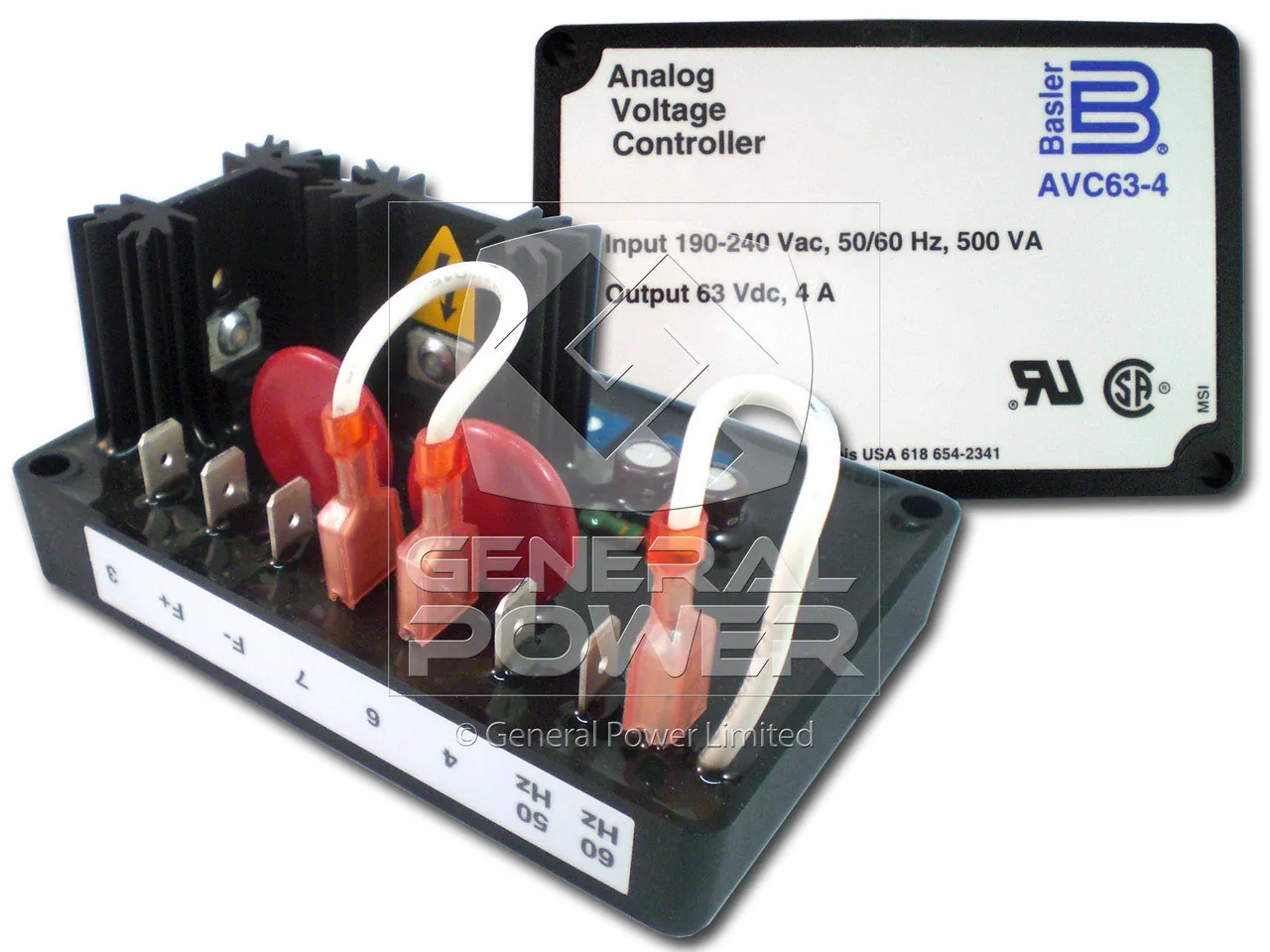
Field notes on this model. Basler describes the AVC63 as the universal regulator that reduces inventory to one device on the shelf, and that is exactly how it is used in the field: one potted analogue AVR that fits most small and mid-size alternators. The sealed housing is what makes it survive engine-room vibration and conductive dust, and there are only three adjustments, so there is very little to mis-configure on site.
Standby versus prime power. A standby set runs a few hundred hours a year and its regulator spends most of its life cold; a prime power set runs continuously and its regulator spends its life at operating temperature. The AVC63-4 is rated for -40 to +60 degC, which is fine in both cases provided the terminal box has any ventilation at all. What changes between the two duties is the capacitor ageing inside the board, not the semiconductor, so a prime power machine should have the regulator inspected on a schedule rather than on failure.
Fusing. Fit the fuse the manual specifies and nothing larger. A bigger fuse does not protect the regulator better, it protects it later. On a AVC63-4 the fuse is there to clear a field short before the thyristor is destroyed, and a 20 A fuse in place of an 8 A one turns a cheap board replacement into a rewind.
Commissioning sequence. Start with the machine at rated speed, no load, and the field disconnected. Confirm the sensing voltage at the AVR terminals is inside the window the board expects, then connect the field with the voltage trim at minimum. Bring the trim up slowly and watch the field current, not the terminal voltage, because the terminal voltage will look correct long before the field current has stabilised on a cold winding.
Why resistance matters more than current rating. A regulator delivers a voltage, and the field decides how much current that voltage produces. A board rated at 4 Adc continuous into a low resistance field will deliver far less into a high resistance one, because the output voltage is the limit. This is why an AVR that is electrically perfect on paper can fail to excite a particular alternator, and why the resistance figure belongs in the quotation rather than in the manual.
Voltage high and unresponsive. If the machine runs to maximum excitation regardless of the trim, disconnect the field and see whether the voltage collapses. If it does, the regulator has failed shorted; if it does not, the field is being fed from somewhere else, usually a shorted thyristor or a mis-wired paralleling circuit. Do not run the machine at full excitation for more than a few seconds while diagnosing, because the winding will not survive it.
Documentation. Insist on the wiring drawing for the exact suffix being supplied. Generic family drawings are the reason installations end up with the sensing on the wrong tap, and the resulting fault is indistinguishable from a faulty board.
Parallel operation is a different animal. A single set on an island load only has to hold voltage. Two sets in parallel also have to agree about reactive load, and that agreement is made or broken by the droop circuit, not by the voltage accuracy. If a site is going to parallel, the regulator choice has to be made with the droop method in mind from the beginning, because retrofitting load sharing onto a board that was never specified for it costs more than buying the right one.
Wiring practice that prevents most call-backs. Run the sensing leads as a twisted pair, separate from the field cables, and land them on the terminals the drawing names rather than on the ones that happen to be nearest. On a AVC63-4 the sensing input draws very little current, which is exactly why it is vulnerable: a loose terminal adds resistance that the regulator reads as a voltage error and corrects by pushing the field up, so the machine runs hot and high for no visible reason.
Jinjia Power Equipment Co., Ltd | Address: No.737, Guanzhang Road, Liaobu Town, Dongguan, China
Phone: 86-13553838770 | 86-0769-89610677 | info@jinjiadongli.com
Jinjia Power, Quality Assured