86-0769-89610677 / 86-13553838770 | info@jinjiadongli.com
Status: IN STOCK, Same day shipping Worldwide available | Brand New, 1 Year International Warranty
* Contact us for pricing and full specifications
| SKU | DECS200N-C2 |
| Brand | BASLER |
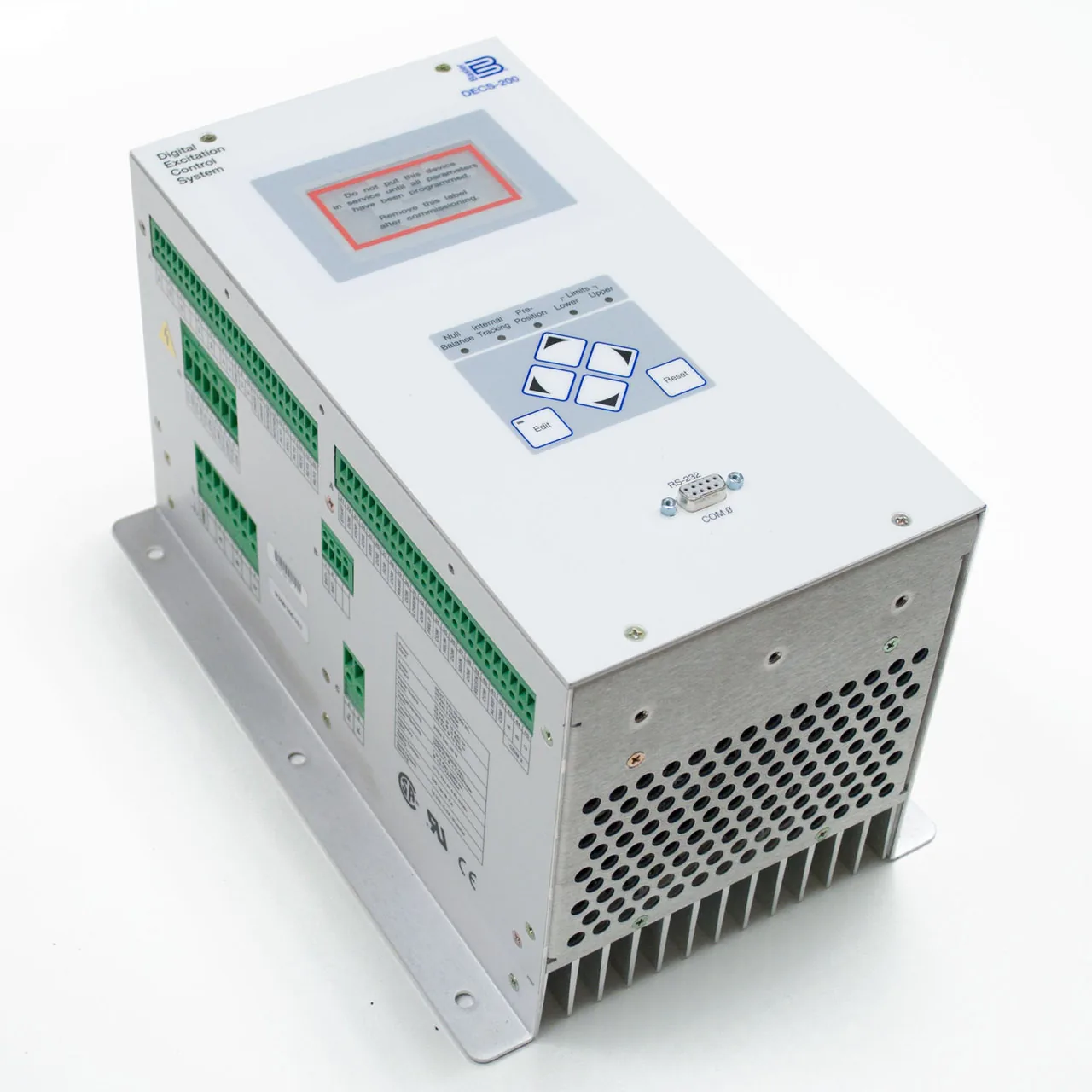
| Model Number | DECS200N-C2 |
| Regulator Type | Digital Automatic Voltage Regulator |
| Excitation System | Self-excited or PMG, single-phase or three-phase power input |
| Sensing Input | True RMS, single-phase or three-phase: 100 V/50 Hz (85-127 V), 120 V/60 Hz (94-153 V), 200 V/50 Hz (170-254 V), 240 V/60 Hz (187-305 V), 400 V/50 Hz (340-508 V), 480 V/60 Hz (374-600 V), 500 V/50 Hz (425-625 V), 600 V/60 Hz (510-660 V) |
| Power Input | Single-phase or three-phase, 50-500 Hz: 56-70 Vac +/-10 per cent at 780 VA, 100-139 Vac +/-10 per cent at 1570 VA, 190-277 Vac +/-10 per cent at 3070 VA |
| Output Voltage | 32 Vdc / 63 Vdc / 125 Vdc at 15 Adc, one model covers all three levels |
| Continuous Field Current | 15 Adc continuous |
| Forcing Current | Current-limited forcing into the exciter field |
| Field Resistance (Min) | Matched to the 32 / 63 / 125 Vdc output selected |
| Regulation Accuracy | 0.25 per cent, the tightest figure in the Basler analogue-to-digital range |
| Response Time | One cycle, with 20 standard stability settings plus one user-defined |
| Frequency Range | 50-500 Hz |
| Under-Frequency Protection | Volts-per-hertz limiter with adjustable knee |
| Voltage Adjustment | External voltage adjust, raise / lower contacts, two analogue inputs (+/-10 Vdc and 4-20 mA) |
| Paralleling / Droop | Reactive droop compensation, voltage matching, auto-tracking between control modes |
| Build-Up Voltage | Builds up from residual voltage |
| Thermal Drift | Negligible, all settings held digitally |
| Operating Temperature | -40 to +60 degC |
| Storage Temperature | -40 to +85 degC |
| Protection Features | Over-excitation limit, under-excitation limit, minimum excitation limiter, seven generator protections, exciter diode monitoring, sequence of events recorder |
| Compatible Alternators | Basler, Stamford, Leroy Somer, Marathon, Marelli and Mecc Alte alternators |
| Mounting | Panel or terminal-box mount |
| Lifecycle Status | Discontinued by Basler, DECS-250 is the successor |
| Availability | IN STOCK, Same day shipping Worldwide available |
| Condition | Brand New, 1 Year International Warranty |
| Warranty | 1 Year International Warranty |
What the DECS200N-C2 is. A Digital Automatic Voltage Regulator built by BASLER for brushless excitation systems. On paper the specification is a list; in service it is a set of limits. The current the board will hold indefinitely is 15 Adc continuous; the field resistance window it will drive without exceeding its output voltage is Matched to the 32 / 63 / 125; the tightest voltage band it can maintain is 0.25 per cent; and the ambient range in which all of that remains true is -40 to +60 degC.
Excitation architecture. Self-excited or PMG, single-phase or three-phase power input. That single sentence decides most of the regulator's behaviour in a fault: whether the field survives a close-up short circuit, whether the machine builds up from residual voltage on its own, and how much the terminal voltage dips when a large motor starts on the same bus. The measurement that settles most arguments is the field current at full load, taken with a clamp meter, compared against the rating on the board.
Sensing. True RMS, single-phase or three-phase: 100 V/50 Hz (85-127 V), 120 V/60 Hz (94-153 V), 200 V/50 Hz (170-254 V), 240 V/60 Hz (187-305 V), 400 V/50 Hz (340-508 V), 480 V/60 Hz (374-600 V), 500 V/50 Hz (425-625 V), 600 V/60 Hz (510-660 V). The sensing circuit is the regulator's only view of the outside world, so its wiring matters as much as its specification. A voltage error introduced by a loose terminal or a long run of untwisted cable is indistinguishable, from the regulator's point of view, from a genuine voltage error on the alternator. If the machine will not hold voltage at all, disconnect the field and measure the sensing voltage first. That one reading separates a sensing fault from a field fault.
Power stage and field drive. Power input Single-phase or three-phase, 50-500 Hz: 56-70 Vac +/-10 per cent at 780 VA, 100-139 Vac +/-10 per cent at 1570 VA, 190-277 Vac +/-10 per cent at 3070 VA, output 32 Vdc / 63 Vdc / 125 Vdc at 15 Adc, one model covers all three levels. Field current rating 15 Adc continuous, forcing capability Current-limited forcing into the exciter field, field resistance window Matched to the 32 / 63 / 125. These are not independent numbers: the output voltage ceiling and the field resistance together set the maximum current the board can actually deliver, and the continuous rating is only reachable at the low end of the resistance window. Static accuracy is measured on a resistive load at constant frequency. Real loads and real governors are neither, so treat the figure as a comparison between boards rather than a promise.
Accuracy and response. 0.25 per cent steady-state accuracy, One cycle, with 20 standard stability settings plus one user-defined, thermal drift Negligible, all settings held digitally. In practice the accuracy figure is the least interesting of the three. What an operator notices is recovery after a load step, which is governed by response and by available forcing current, and what a maintenance engineer notices after two years is drift, which is governed by the reference circuit and the ambient temperature inside the terminal box. Static accuracy is measured on a resistive load at constant frequency. Real loads and real governors are neither, so treat the figure as a comparison between boards rather than a promise.
Frequency behaviour. Rated for 50-500 Hz, with Volts-per-hertz limiter with adjustable knee. The frequency-sensitive function exists to protect the prime mover, not the alternator: as engine speed falls the regulator reduces excitation so the alternator stops demanding torque the engine cannot supply. Without it, an overloaded engine is dragged down until it stalls, and the alternator is blamed for a fault that belongs to the fuel or governor system. Static accuracy is measured on a resistive load at constant frequency. Real loads and real governors are neither, so treat the figure as a comparison between boards rather than a promise.
Paralleling. Reactive droop compensation, voltage matching, auto-tracking between control modes. On a single set this circuit does nothing. On two or more sets it is the only thing that stops the machines from exchanging reactive power in a slow oscillation, and it is the first place to look when a parallel installation shows a circulating current that nobody can explain. Where a spare is being held, hold the drawing with it. A board without its wiring diagram costs a shift of production time to install.
Protection built into the regulator. Over-excitation limit, under-excitation limit, minimum excitation limiter, seven generator protections, exciter diode monitoring, sequence of events recorder. These functions protect the alternator and the regulator, not the installation. Downstream protection, loss of mains and reverse power all belong to the controller, and a site that relies on the AVR for them is a site that will eventually trip in a way nobody can explain. Any AVR that has been in service for more than ten years is running on borrowed time, and the failure always happens at the least convenient moment.
What it fits. Basler, Stamford, Leroy Somer, Marathon, Marelli and Mecc Alte alternators. Lifecycle status: Discontinued by Basler, DECS-250 is the successor. Both halves of that sentence matter at order time. A board that fits perfectly but has been discontinued is a different commercial decision from one that fits and is in current production, and the price difference rarely reflects the difference in risk. An alternator that has been rewound needs its field resistance re-measured, because a rewind commonly moves it by ten to twenty per cent in either direction.
Field notes on this model. The DECS-200 is a four-mode digital regulator: automatic voltage, manual field current, power factor and reactive power. Two features matter when it is compared with an analogue AVC. The first is the 0.25 per cent regulation accuracy, roughly four times tighter than a typical analogue AVR. The second is the built-in exciter diode monitor, which flags a failing rotating rectifier before it takes the machine off line. Basler has discontinued the DECS-200 and the DECS-250 is the successor; stock offered here is new old stock or OEM-equivalent, and it drops into an existing DECS-200 installation without rewiring.
The retrofit case. Most DECS200N-C2 sales are retrofits, not new build. The machine is ten to twenty years old, the original board has failed, and the drawing is gone. In that situation the useful evidence is the exciter field resistance measured with a meter, the residual voltage measured at the AVR terminals with the machine turning at rated speed and no load, and the nameplate kVA. Those three readings will identify a compatible board even when the original part number cannot be found anywhere.
The terminal box is a hostile place. Engine vibration, radiant heat from the exhaust and conductive dust all arrive at the same panel. Mount the DECS200N-C2 on the resilient side of the box if there is a choice, keep it off the hottest wall, and make sure the lid actually closes over the wiring rather than pinching it. A regulator that is mechanically stressed will eventually crack a solder joint, and the resulting fault looks exactly like a failed semiconductor.
Load step test. Apply and remove at least half rated load and watch the recovery. A healthy regulator pulls the voltage back inside one per cent within a few cycles. If the recovery is slow but the final voltage is correct, the problem is response, not accuracy, and on an analogue board that usually means the field circuit is seeing more resistance than it was set up for.
Why resistance matters more than current rating. A regulator delivers a voltage, and the field decides how much current that voltage produces. A board rated at 15 Adc continuous into a low resistance field will deliver far less into a high resistance one, because the output voltage is the limit. This is why an AVR that is electrically perfect on paper can fail to excite a particular alternator, and why the resistance figure belongs in the quotation rather than in the manual.
Voltage drifts with ambient temperature. If the voltage is correct cold and low hot, the thermal drift of the regulator and the temperature coefficient of the field are adding up in the same direction. The DECS200N-C2 is specified at 0.25 per cent, the tightest figure in the Basler analogue-to-digital range; a drift of a couple of per cent over a fifty degree swing is normal for an analogue board and is not a fault.
New, old stock or refurbished. Discontinued regulators are available as new old stock, which is genuine and works, and as refurbished, which is a gamble on how the board was stored. Ask which one is being quoted. A board that has spent ten years in a damp warehouse has aged electrolytics even though it has never been installed.
The retrofit case. Most DECS200N-C2 sales are retrofits, not new build. The machine is ten to twenty years old, the original board has failed, and the drawing is gone. In that situation the useful evidence is the exciter field resistance measured with a meter, the residual voltage measured at the AVR terminals with the machine turning at rated speed and no load, and the nameplate kVA. Those three readings will identify a compatible board even when the original part number cannot be found anywhere.
Mounting orientation and cooling. Most AVR boards are convection cooled and assume the heatsink fins are vertical. Mounting a DECS200N-C2 flat on its back inside a sealed box shortens its life even though the ambient temperature reads acceptable, because the local air around the thyristor is far hotter than the box average.
Jinjia Power Equipment Co., Ltd | Address: No.737, Guanzhang Road, Liaobu Town, Dongguan, China
Phone: 86-13553838770 | 86-0769-89610677 | info@jinjiadongli.com
Jinjia Power, Quality Assured