86-0769-89610677 / 86-13553838770 | info@jinjiadongli.com
Status: IN STOCK, Same day shipping Worldwide available | Brand New, 1 Year International Warranty
* Contact us for pricing and full specifications
| SKU | M00FA122A |
| Brand | MARELLI |
| Model Number | M00FA122A |
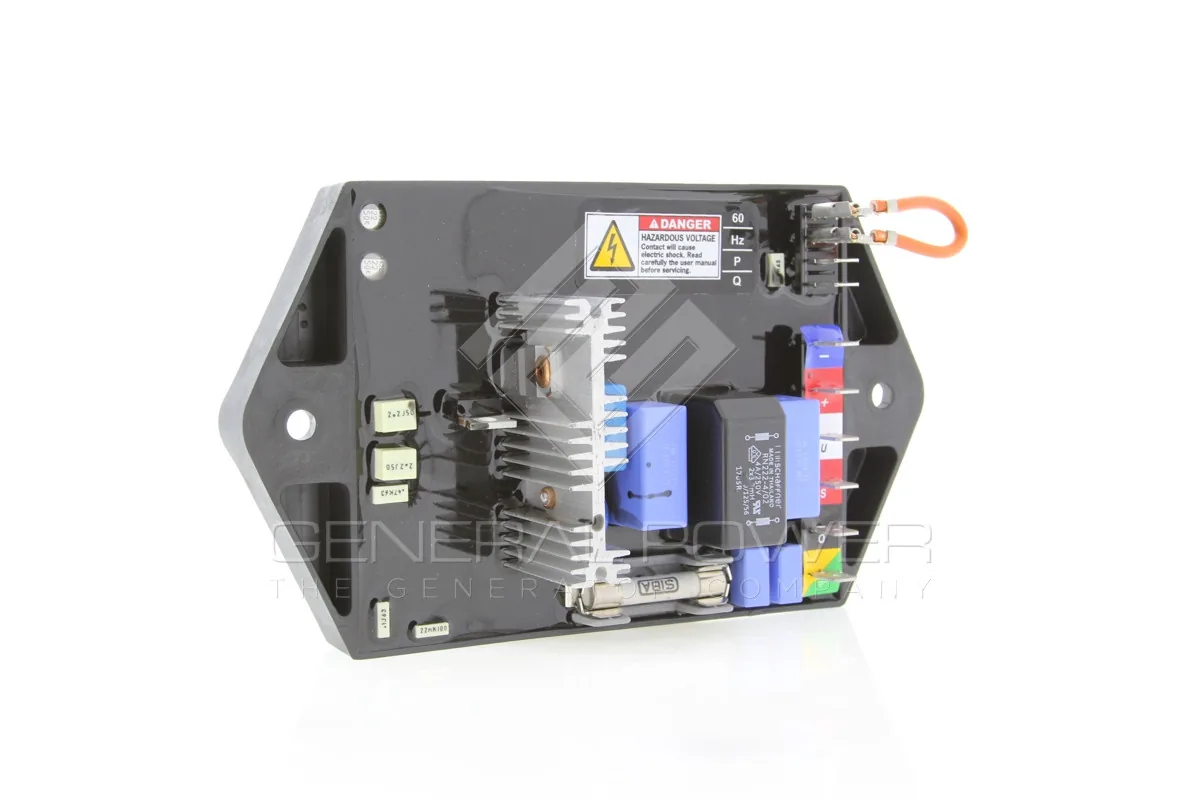
| Regulator Type | Analogue Automatic Voltage Regulator, Mark X platform |
| Excitation System | PMG fed, designed for Marelli MJB alternators with a permanent magnet pilot exciter |
| Sensing Input | Single-phase, 170-480 Vac, 50 / 60 Hz, +/-10 per cent tolerance |
| Power Input | Auxiliary winding or main terminals, 170-277 Vac at 100 / 120 Hz, +/-10 per cent |
| Output Voltage | 100 Vdc maximum |
| Continuous Field Current | 8 Adc continuous |
| Forcing Current | 15 Adc for 1 minute |
| Field Resistance (Min) | 3-20 ohm, or 3.5-20 ohm on some builds |
| Regulation Accuracy | +/-0.5 per cent from no load to full load at 0.8 power factor on balanced undistorted load at constant frequency. Steady-state accuracy +/-0.1 per cent, or +/-1 per cent with 4 per cent engine governing |
| Response Time | One cycle |
| Frequency Range | 50 / 60 Hz |
| Under-Frequency Protection | Under-frequency limiter with an adjustable knee |
| Voltage Adjustment | A 100 kohm external potentiometer gives +/-5 per cent of rated voltage, and an external DC signal of -3 / +3 V suits a power factor controller |
| Paralleling / Droop | Reactive droop compensation, +/-20 per cent |
| Build-Up Voltage | Builds up from 5 Vac residual |
| Thermal Drift | +/-0.5 per cent for a 50 degC ambient change after a 10 minute warm-up |
| Operating Temperature | -30 to +70 degC |
| Storage Temperature | -40 to +80 degC |
| Protection Features | Under-frequency limiter, over-excitation limiter, internally replaceable fuse |
| Compatible Alternators | Marelli MJB 225-500 frame alternators |
| Mounting | Panel or terminal-box mount |
| Lifecycle Status | In production |
| Availability | IN STOCK, Same day shipping Worldwide available |
| Condition | Brand New, 1 Year International Warranty |
| Warranty | 1 Year International Warranty |
Short version. The M00FA122A is a Analogue Automatic Voltage Regulator, Mark X platform. It supplies the exciter field, senses the alternator output and corrects the difference several times a second. Its rating is 8 Adc continuous, its field resistance window 3-20 ohm, its accuracy +/-0.5 per cent, and it is intended for machines whose field winding sits inside that window. Read the rest of this page as the detail behind those three figures.
Excitation architecture. PMG fed, designed for Marelli MJB alternators with a permanent magnet pilot exciter. That single sentence decides most of the regulator's behaviour in a fault: whether the field survives a close-up short circuit, whether the machine builds up from residual voltage on its own, and how much the terminal voltage dips when a large motor starts on the same bus. If the machine will not hold voltage at all, disconnect the field and measure the sensing voltage first. That one reading separates a sensing fault from a field fault.
Sensing. Single-phase, 170-480 Vac, 50 / 60 Hz, +/-10 per cent tolerance. The sensing circuit is the regulator's only view of the outside world, so its wiring matters as much as its specification. A voltage error introduced by a loose terminal or a long run of untwisted cable is indistinguishable, from the regulator's point of view, from a genuine voltage error on the alternator. Vibration kills more regulators than heat does. If a board has failed twice in the same machine, look at the mounting before looking at the supplier.
Power stage and field drive. Power input Auxiliary winding or main terminals, 170-277 Vac at 100 / 120 Hz, +/-10 per cent, output 100 Vdc maximum. Field current rating 8 Adc continuous, forcing capability 15 Adc for 1 minute, field resistance window 3-20 ohm. These are not independent numbers: the output voltage ceiling and the field resistance together set the maximum current the board can actually deliver, and the continuous rating is only reachable at the low end of the resistance window. Counterfeit regulators are a real problem on the widely copied boards. Buy from a source that will state where the board was made.
Accuracy and response. +/-0.5 per cent steady-state accuracy, One cycle, thermal drift +/-0.5 per cent for a 50 degC ambient change after a 10 minute warm-up. In practice the accuracy figure is the least interesting of the three. What an operator notices is recovery after a load step, which is governed by response and by available forcing current, and what a maintenance engineer notices after two years is drift, which is governed by the reference circuit and the ambient temperature inside the terminal box. A voltage that is correct at no load and low at full load is almost never an accuracy problem. It is a current limit, a resistance problem or a cable problem.
Frequency behaviour. Rated for 50 / 60 Hz, with Under-frequency limiter with an adjustable knee. The frequency-sensitive function exists to protect the prime mover, not the alternator: as engine speed falls the regulator reduces excitation so the alternator stops demanding torque the engine cannot supply. Without it, an overloaded engine is dragged down until it stalls, and the alternator is blamed for a fault that belongs to the fuel or governor system. If two identical sets behave differently on the same load, swap the regulators before swapping anything else. The result tells you which side of the machine the fault is on.
Paralleling. Reactive droop compensation, +/-20 per cent. On a single set this circuit does nothing. On two or more sets it is the only thing that stops the machines from exchanging reactive power in a slow oscillation, and it is the first place to look when a parallel installation shows a circulating current that nobody can explain. If the machine will not hold voltage at all, disconnect the field and measure the sensing voltage first. That one reading separates a sensing fault from a field fault.
Protection built into the regulator. Under-frequency limiter, over-excitation limiter, internally replaceable fuse. These functions protect the alternator and the regulator, not the installation. Downstream protection, loss of mains and reverse power all belong to the controller, and a site that relies on the AVR for them is a site that will eventually trip in a way nobody can explain. An alternator that has been rewound needs its field resistance re-measured, because a rewind commonly moves it by ten to twenty per cent in either direction.
What it fits. Marelli MJB 225-500 frame alternators. Lifecycle status: In production. Both halves of that sentence matter at order time. A board that fits perfectly but has been discontinued is a different commercial decision from one that fits and is in current production, and the price difference rarely reflects the difference in risk. On a machine that has been standing for months, check residual voltage before condemning anything: a winding that has lost its remanence will not build up on any regulator.
Field notes on this model. The Mark X is fully resin-encapsulated, which is what makes it survive humidity, conductive dust, salt spray and the vibration of a marine or offshore installation. It is designed around a PMG, so excitation holds up through a short circuit. Marelli also publishes the external control interface: a 100 kohm potentiometer gives +/-5 per cent voltage trim, and a -3 / +3 V DC signal lets a power factor controller drive it directly.
Parallel operation is a different animal. A single set on an island load only has to hold voltage. Two sets in parallel also have to agree about reactive load, and that agreement is made or broken by the droop circuit, not by the voltage accuracy. If a site is going to parallel, the regulator choice has to be made with the droop method in mind from the beginning, because retrofitting load sharing onto a board that was never specified for it costs more than buying the right one.
Field cable sizing. The field circuit carries DC at low voltage and high current, so volt drop matters more than ampacity. Size the cable so that the drop at 8 Adc continuous stays under about one volt, and torque the terminals to the manufacturer figure. A field circuit that loses half a volt in the cable is a regulator that cannot reach full forcing when the load steps.
Under-frequency check. Run the set at reduced speed and confirm the volts-per-hertz knee actually operates. This test is skipped on most commissioning sheets and it is the one that saves an engine on a real overload, because the knee is what stops the alternator from loading a lugging engine into a stall.
Temperature drift of the field. Copper rises about 0.4 per cent in resistance per degC, so a field that measures 12 ohm cold will measure around 15 ohm at a 70 degC winding temperature. A regulator set up on a cold machine and never re-checked will therefore be running at a different operating point every time the season changes, and the symptom is a voltage that is correct in winter and low in summer.
Intermittent loss of excitation. Intermittent faults are almost always mechanical: a crimp that was never properly made, a terminal screw that was tightened onto insulation, or a board that is flexing. Wiggle-test the harness with the machine running at no load and watch the field current meter.
Lifecycle status. If the board being replaced is discontinued, price the current replacement at the same time as the old-stock option. On a machine that is going to run for another ten years the current production board is almost always the cheaper decision even when the old stock is available.
What the customer is actually buying. When a regulator is quoted as a replacement, the buyer is not purchasing a circuit board. They are purchasing the certainty that the set will hold voltage on the next load step. On the M00FA122A that certainty comes from the combination of 8 Adc continuous continuous field current and the One cycle response, and it disappears the moment the field resistance drifts outside the window the board was set up for.
Wiring practice that prevents most call-backs. Run the sensing leads as a twisted pair, separate from the field cables, and land them on the terminals the drawing names rather than on the ones that happen to be nearest. On a M00FA122A the sensing input draws very little current, which is exactly why it is vulnerable: a loose terminal adds resistance that the regulator reads as a voltage error and corrects by pushing the field up, so the machine runs hot and high for no visible reason.
Jinjia Power Equipment Co., Ltd | Address: No.737, Guanzhang Road, Liaobu Town, Dongguan, China
Phone: 86-13553838770 | 86-0769-89610677 | info@jinjiadongli.com
Jinjia Power, Quality Assured